E458: Aleks Woodroffe - "Supporting Senior Sniffers"
Ever wondered how scentwork dogs' abilities change as they age? Many dogs who got started in scent sports right as the sport took off are now hitting their senior years. In this episode, Aleks Woodroffe joins Melissa Breau to talk about how age impacts the nosework dog, what aging gracefully looks like for the scent work team, and how to keep senior sniffers in the game.
Transcription
Melissa Breau: This is Melissa Breau and you're listening to the Fenzi Dog Sports Podcast brought to you by the Fenzi Dog Sports Academy, an online school dedicated to providing high quality instruction for competitive dog sports using only the most current and progressive training methods. Today I'll be talking to Aleks Woodroffe about nose work for senior dogs. Hi Aleks. Welcome back to the podcast.
Aleks Woodroffe: Hello. Thanks for having me back.
Melissa Breau: Awesome. So just to start us out, do you want to share a little bit about you, kind of who you are and a bit about your current dogs?
Aleks Woodroffe: Sure, yeah. I am a full time nose work trainer as well as a massage therapist, kind of as my main thing for canines. So that is a lot of my job and I do a lot of it. So I've been teaching Fenzi the massage course.
I think we're three years now that we've been doing that. So it's really kind of fun that we've been able to offer that three through the system and it's massage your own dog kind of thing, not teaching you how to massage other dogs. But there's lots of cool courses out there for that. But I do that and my business is Release Canine. I'm located here in Phoenix, Arizona and I do a lot of traveling for competition as well as I am a certifying official for NACSW and a judge for AKC in ASCA.
So I get out there, I watch a lot of dogs, I do a lot of scent work and then I also put my hands on dogs. So I'm really kind of loving all that multimodality that I can kind of address with that. I've got currently three dogs so I'm going to start at the youngest and then kind of go up from there. Vespa I have, she's 10 month old.
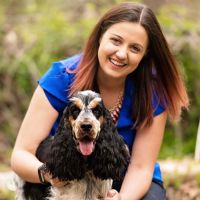
English cocker. It's my first English cocker. I grew up with a cocker and so wasn't training then, but I definitely am in love with this little one. She's going to be so much fun, so eager to learn, so much drive. So we're having a lot of fun. She's been playing a little bit of AKC scent work, got her ORT titles. She's really kind of stepping up and kind of being the dog that I was hoping her to be.
So I'm really excited about that. Gonna take, take the fall off with her. She's kind of starting agility ish. But her main thing is going to be scent work. Maybe I'm just kind of seeing like little pieces. I'm like oh, maybe I should go through the Fenzi team because I really love that foundation for puppies. So I think we're probably going to play with that all summer. And then I've got George who's my 5 year old flat coated retriever.
He's NCSW elite level. We're having a lot of fun in there. And AKC Master level playing detective a little bit. He is the middle child because I do have my older dog who's still playing in Masters and because of her age I kind of want to keep playing because she can. And so he doesn't get to play very often. That's the problem with our sport is you can only play with one dog at a time at each level.
And so he's playing a lot more excellent level akc. And then my schedule doesn't line up for any NCSW Elite trials very often. So we've been kind of stuck a little bit on that back burner and maybe next year will be his year and so then he can get playing a little bit more. We are going to the flat coat national specialty though, so that's in June. So we're going to have a lot of fun doing that fieldwork, obedience, agility, all the fun stuff.
And then I've got Tana, my flat coated retriever. She's 10 years old now, which is awesome. She's been through way too many things. She's been through thyroid cancer and bloat and puppies and yeah, so she's had a very active life. We've got her elite P title, summit titles and work Master League 3. Like she's done all the things, having so much fun doing all the things. And so she's my senior dog.
She's my dog that I get to play all the things with and have that little old, it feels good teamwork kind of thing that's happened. She is slowing down a little bit and I'm picking and choosing a little bit more. So she doesn't like to travel very much. So we're kind of changing things up like that. Yeah, gotcha. And I like that you started with the youngest and ended the oldest.
Since we're talking about senior dogs, so. Exactly. So what makes Nose Work such a good fit for our senior friends? Well, I think a big thing is that nose work is a little unique in a lot of the sports. So in most other sports we've got like agility where their bodies start slowing down and there's a limitation that you can do injuries that happen and it really Just takes you out of the sport completely, even obedience.
And to me, who's not an active obedience person, I go, well, you could still do a lot. But honestly, when I work massage on like, I do a lot of Schutzhund dogs, IGP dogs and work body work, fitness, things like that, they have a lot of wear and tear on their bodies from healing and the obedience piece of it. So it's not like you can just keep going forever.
It still does have a pretty impact, a pretty big impact on their bodies. And then a lot of other sports kind of do that. Conformation. Yeah. Technically you could keep going until they get older, but you're not going to be winning necessarily all the time. Some dogs are doing awesome. We've got a few in our local area and she is just rocking it with her old Brittany. And every time I see I'm like, take it.
But she keeps our dog in great shape. And so I think that's kind of the thing is we have to be like working so hard if we want to be doing any other sport versus nose work. I could take a dog that is not even feeling all that great. But actually through nose work, they're getting a lot of movement. They're getting a lot of activity mentally and physically that maybe otherwise they're not getting.
So that's kind of a cool piece about nose work is that senior dogs actually can do a little bit better. Um, I've also seen a lot of dogs retire to nose work, so they can't do any more sports. And so then they go, okay, what is my next option? Oh, let's keep doing this. Because you can still work as a team. You can still keep them active going out because they're all used to that, leaving the house and doing that if you're in competition sports already.
So it's kind of a nice little backup, I find. And it doesn't mean that they can't do well. Right. That's kind of the other piece is that you could still do well with a senior dog. It doesn't mean that you have to have a young one versus so many other sports. You need to start young.
Melissa Breau: Yeah. So how does nose work kind of meet needs that other types of training or exercise, you know, maybe can't for an older dog or doesn't for an older dog?
Aleks Woodroffe: Yeah, I think the big thing is it's movement. Right. And my mom, she's Olympic level dressage coach growing up, and so I heard a lot of things and she's done through pain management courses and stuff. And so she once told me that movement is health and it's so very, very true. So with nose work, we are creating movement. You can't do the sport standing still. You have to be moving.
And often through that movement, it is dog led. So it's whatever the dog feels comfortable doing. If the dog is sore doing something, they're probably not going to do that thing. One, we can kind of see it and we can kind of get an advanced warning. But also they're pushed just to the limit of doing that thing, which sometimes can be very helpful if it's like restrictive because they're just tight or they're sore in an area.
And so as long as we are doing pain management for an older dog, it's actually keeping them moving, moving through those joints, maintaining the muscle mass and then they're not going to deteriorate quite so quickly. So it's really kind of a nice way that way that nose work can really kind of fit in those little gaps that otherwise, honestly, when we're, our dogs are retired, they sit at home, then we're losing a lot of that movement.
We're losing a lot of that opportunity to keep them flexible and moving around and getting that going. Um, it's also mentally going to help them a little bit more because they're going to practice staying focused. I know this works for humans, right? I like, I've got some students, I've got many students here in Arizona that are seniors and they're retired. It keeps you going out, it keeps you social, it keeps you exposed to novelty, exposed to different things, which then makes life a little bit more comfortable because we're not so startled with new things.
So I think it works quite a bit better that way too. So if somebody wants to do nose work with their senior dog, does the dog need to have had at least two, you know, some exposure to scent sports before they became a senior or can a senior with absolutely no scent work foundations learn the game. You know the old question, can old dogs? Yeah, exactly. I really think that you can just pop right into it.
So what's really kind of cool is I've even had students as old as 12 start. And this is the dog, human. Really young, but yeah, the 12 year old dog. And uh, she was retired agility dog. And she's like, I just want to come and play. Is she the most enthusiastic, driven dog to go do the sport? No, but that's okay. She came into it learning how it's going to go and understanding all those little things.
What's kind of interesting is nose work is something that they've been doing. We're just training it on an essential oil. The dogs have been sniffing from day one. They've been trying to find the treat that fell. They're watching cookies that are falling off of. Or carrots or whatever when you're cooking, right. They're doing that kind of thing. So it's not like it's deteriorating necessarily, and it allows them to get out there and figure those kinds of things out.
All we need is a dog that's motivated. I do find it's a little bit more difficult if the dog is like, maybe in pain or maybe they're just not feeling so hot, and then we're trying to get them motivated to play the sport. We can get some limitations there. But as long as the dog is able to be motivated somehow, even if it's praise joy, I had one dog that was praised.
Is it great for competition? It starts to deteriorate. But when we're talking about senior dogs learning the sport and just doing it, do whatever, right? Make what the dog wants to be the happy thing. Chances are most people are doing some version of scent work with primary rewards, meaning toy food or ourselves. Honestly, okay, hold the dog. I'm gonna go hide for them, right? Um, or hiding on our dogs when they come upstairs.
And I'm gonna already be hiding in a corner. Right? Those are little games that we might be playing already. So I might drop a treat during training. Maybe I was doing obedience and we're doing rewards and then toss cookie for them to go get wearing grass. He's doing scent work to try and find that cookie and then come back into position. That's nose work. Right. So they're doing it.
We just have to teach them with the different target odor. Would you measure success differently with a senior dog doing nosework than you might for a younger dog? You know, how would you kind of define success if you're working with a senior? I think it really depends on the team. Depends on the level of competition. Right. So if we're starting novice with an older dog or we've just kind of dabbled around and, and just playing novice, it's really not going to look much different.
Right. The success is find the one hide. Um, does it have to be the fastest moving dog? Not necessarily. But honestly, novice level, it is often the fastest moving dog that reacts the quickest to odor, that will find that hide. And so then, yeah, placements are going to probably go there. And it doesn't have to do with age, it has to do with movement. Right. Speed of movement.
I've seen many young dogs that are not moving as quickly as that lab. Right. Um, and that's kind of the sport and how the sport works, but with kind of in mind. If we look at the upper levels, the dog has been working scent work for five years, 10 years. By the time that they get to senior level, it's not uncommon for a summit, an NCSW summit trial, to be won by a senior, because it is the team that is the most efficient, it is the team who can work together, read the understanding.
And that does take years to develop. So it is not uncommon for that level to be a senior dog. And that's really like when I was thinking about this course is we are. Scent work kind of started up and I think it's because of AKC. Scent work really started up about 10ish years ago. So a lot of our dogs, if you've kind of started AKC at the beginning or pretty close to it, they're all getting right into that senior kind of pocket.
And I think as a result, we have a large number of senior dogs now competing at the top levels of competition, whether they've slipped into NCSW or where they're before or they're getting to that point. And so just kind of understanding that, that success, then for that upper level, it can be the same, right? We can, because the team has been really strong. They're figuring each other out, they've had those years to develop that mutual language and that's working.
But we also have some limitations, right. And we have to start recognizing those limitations. So it might be adjusting how we kind of do our trial or our training so that we can best have our dogs at that same success level. So an example is Tana. She's 10 now. She doesn't love to trial or travel. She loves to trial. But I've noticed on second days of competition, she's tired and by the end of the day she's quite a bit more tired, which then for her, because she's expecting herself to move quickly, herself to feel good and sharp, she's getting frustrated, she might go into handler focus.
And so that kind of stuff is happening on the end of day two changes my perspective because I might expect her to be much more active, much more eager. Right. And so then as a result, I might shift things a little bit and go, we're only going to do one day. Yeah. It means letting go a little bit of some titles. Maybe I want to capture whatever that extra title is right.
But for her, for us to play, and she likes to play fast and hard, I'm going to give her just one day and then she can have a recoup. Maybe it's a three day trial. I can do one in three. She doesn't travel as much. So it's just kind of understanding what is the new framework for what that dog is and the success might still be the same. We've just changed how that event is going to be displayed. That makes a lot of sense.
Melissa Breau: Can you talk a little more about how scent work can support cognitive function for aging dogs? I mean, can it benefit dogs who even have already maybe begun to show some of that cognitive decline?
Aleks Woodroffe: Yeah, for sure. This is actually, it's a cool question because it's a new, like there's so much science going on about this right now.
And a paper hit just end of last year and so that was from Montgomery et al. It was called Evaluating Effects of Aging on Dog Olfactory Performance. And so what they did is they found a study, or they did a study of 65 dogs. Only 44 ended up finishing it, but they went from five years to about 12 years old. And they were looking at the effect of age on olfactory systems as well as cognitive systems.
And so when they were going through that, they were looking at the performance effect and seeing is there an effect of age on their ability to do any of that? And what was really cool is by the time they got to the end of the study and figure out all those pieces is they didn't really see a huge cognitive effect, but they definitely saw an effect of age on olfactory.
But the dogs who were trained, the dogs who had training had much less and it was almost protective against the decline. So when you do some sort of scent work training, especially I think when we're doing like nose work training where we're asking the dog to be very specific to a very specific thing, their performance, their accuracy remains quite strong. And we can continue with that. I did a lot of training way back when with Fred Heifers and he had once said this and I haven't found the paper and I know he has the paper somewhere because that's the type of guy he is.
But he was showing that the olfactory cells regeneration actually slows down. So it's a physical change as the dogs are aging. I did find a paper from 1996 that might have been it, that was showing the decline at 14 years old. And I have a feeling because they were seeing this effect at, like, as they're getting up to 10 years old and there. So there's probably an effect a little bit earlier.
Some of the problem with science is that it is small study sizes. So that was 22 dogs, this is 44 dogs. Right. And we're talking about thousands and thousands of dogs that do the sport. So I'm sure there's a lot of little extra pieces, and that's why I'm really excited that there's so much science going on, because they keep looking in further and further and really kind of exploring that concept.
But in short, they've been able to show with a lot of these science papers and studies that there is a decrease in the cognitive decline which can keep the dogs a little bit sharper. With that being said, I've had dogs in my classes that start to look a little bit like they've almost got canine dementia kind of starting on in. And it's pretty rare, actually. But I do have a lot of senior client dogs, and so I've seen them, and they just kind of like pause out a little bit, or maybe it's a little bit of a avoidance of an alert behavior because it's physically uncomfortable.
Right. So that kind of stuff that can be happening as well. Are there, you know, signs that a senior dog is still mentally engaged, still enjoying the work that you look for? Are there, you know, tips for keeping things fun, making sure we don't cause frustration or confusion? Yeah, I find a lot of it is going to be looking at clarity. Right. If the dog understands what they're doing, that's definitely going to be leading them to be more confident and clear and having fun with the kind of game and kind of going back to foundations, maybe, especially if you've got an older dog that has been competing for a while.
So we've been doing it. We've been doing all the sports, and we want to be training up, up, up, up. And then we forget that we have to maintain motivation. We have to maintain that clarity. Uh, and I know this is really hard, myself included. Right. We want to be working the bigger spaces, the harder things, and we forget that those easy hits, those clean hits where the dog just goes, oh, here it is, and then they get so many cookies.
That is worth it. Because the dog then has enough endurance and motivation to keep going because it was an easy hit. And so then they think the next one might be an easier hit than what it is, and they get a little bit more resilience. Then maybe if we didn't do that Then it's all hard. I don't know about you, but as I'm aging, I'm going. I don't really feel like I have enough energy for that anymore.
Right. So that can be kind of affecting it a little bit. Now when we're kind of thinking about those things, it's understanding that we want to make sure we're reinforcing and building the joy and all the pieces, but knowing that the alert behavior itself can be a little bit harder. I know Julie Simons has a class going on right now for, like, alert behaviors, for nose work and reinforcement markers, and I love it.
I think it's so perfect. And it kind of fits exactly to this, because what I find is with the alert behaviors, it starts changing slightly as the dogs are aging. So we might have a situation where they are sore and they might be not as fit or able to do a sit or a down or even crouch kind of position that we might be expecting them to have.
I've even seen with some elder dogs, elder senior dogs, where they're lifting a paw, and so maybe they're pawing on a container, just a light little tap. But that act of actually shifting the weight to the other parts of their body to lift their shoulder is a little painful. And so because of all of that, then you don't have an alert behavior. Then can you call it Right.
So all of those things, and then we're not calling it. So the dog says, is it even worth it? And so we think, oh, maybe our dog is not wanting to play this game anymore, when in fact, they're totally happy playing the game. They just want you to be less stingy, Believe them a little bit more. And we have to become that better teammate to recognize that they are expecting us to step up.
Because we've been expecting so much from them for all these years, we might need to step up a little bit more. It will look a little different than a younger dog. Right. So if a younger dog is going in with joy, it might be a lot of enthusiasm and movement for a senior dog. They're going to be more efficient, typically with their lines. It's going back to that.
I don't really have enough energy to do all the things anymore. That's silly. Why should I expend all that extra energy? So you see a little more efficiency. There comes our placements. Because they don't want to waste time going to the edge. I'm just gonna go to the hide. Feed me here, please. Right. So you can start seeing that kind of Effect and age, experience, understanding arousal is not necessarily as big of a problem.
So all of those things can help. But in general, clarity creates the confidence. So if we can have clarity in how we set up our searches, what we're expecting from our dogs, normally we're going to see that motivation maintain or even increase if we've been seeing that decrease a little bit.
Melissa Breau: You're talking about some of the physical challenges in there. Are there physical adaptations that handlers should consider when they're training or competing with their senior dog?
Are there physical changes to maybe watch for, to suggest adaptations? You know, how do you know, maybe change your search setup or, you know, different aspects of the sport to accommodate mobility limitations or decrease stamina or some of those other pieces? Yeah, yeah. So the physical piece we could talk about in the search, right. Because we're asking for our dogs to continue walking maybe on sensitive surfaces. Like, I was just bringing Tana a trial that we had recently had those big, like hard rocks, so it's kind of like 2 inch rocks in the parking lot to get from the parking lot into the search.
The search itself was fine, but walking from the car to the parking or the search was a little painful on her feet. So we could consider booties so we can protect the dog's feet. They might be more sensitive to heat as well. But I find a big one is senior dogs and their feet just get so tender. So we might be considering boots, because boots can protect their feet.
They could be more comfortable with it and then they're able to continue working. Um, if you have a smaller dog, you might be lifting them up through those areas. But if you have rocks in your search, maybe we have to be working with that or the heat or uncomfortable kind of surfaces in and out of the car is also a big piece for senior dogs. We might be ex.
Like nose work is crating out of your vehicle. There are some situations and some areas that are going to be more likely to create out of buildings and you bring in your crate. But in the vast majority of situations, we crate out of our vehicles for nose work. And because we create out of our vehicles, the dogs are jumping in and out of the vehicles, or you're lifting them in and out of the vehicle.
Maybe having a step or a ramp can be very helpful because then we can kind of control that a little bit. I have not put a stepper ramp in my own, but I am lifting my dog in and out of the vehicle. And I can tell you that's a little sore on my back. I've seen people even have like a little step that they can pull out. It's a collapsible step or climb.
If you've got enough room in your vehicle, just pull out a climb itself. They're pretty big. They're nice little steps for a lot of SUVs. It's trying to figure out how to manage that a little bit. Because every time the dog is jumping out of the vehicle, they're putting a lot of strain on their front end because that's a lot of collection in a very tight space. It's not like they are jumping and running.
It is tight and often turning. This happens at home in a garage. And it is a common reason why. As a massage therapist, I work on somebody's dog because their shoulders are sore because they keep jumping out of the vehicle. And the nice and tight, um, it can also happen when we're going back in the vehicle. If their hind end is no longer super strong. Um, and we might be expecting that they can jump and then they're missing or they're not quite getting up there.
So you might just have to be ready. Maybe a harness is a good option so that you can guide and help them to go in and out of the vehicle if you're not able to hold onto them. Um, and even with smaller dogs, it's good to remember that their backs are going to be a little sore. As the dog ages, it's not uncommon to get arthritis or get just aches and pains and sore backs and things like that.
Right. So all of that happens as we're aging. And if you're just yanking your dog up and maybe we're kind of used to that, the dog's back might not be supported completely. So two hands on the dog is normally how you're supposed to be holding a dog, especially if they're long back dogs. So one kind of on the chest or kind of around the front legs and then one underneath the belly so that we're able to support the spine so it's not twisting and turning and dropping, which is something that we might not really realize all the time.
But having two hands on our dog can be important, especially when they're little. Um, so other things that we might be considering is arthritis that can be popping up. And yeah, we can be talking to our vets and pain management is a very active piece of that and making sure that we're on those things because it will affect the performance a hundred percent. If the dog is sore, they don't want to be moving.
They don't want to be thinking and you're going to get a different performance out of it, even if the dog wants to do it. So pain management, it doesn't have to be drugs, but that is one option. It's not a bad option, but there's a lot of other things like fitness. I know Kelly Daniels has her senior sniffer or senior class, which I love because it's perfect. We need to be working things at the dog's level, so that's going to be a piece of it.
But you might be exploring braces, right? So something that you can actually put on a joint that's not as strong anymore and brace it so then you're not getting inflammation that's being caused by training or competition. And then the dog is feeling better overall and we're slowing that deterioration of the joint. So hawk braces, knee braces, things like that, that would be something to explore with your vet.
They do make like back on track jackets, back on track, knee braces and things like that. And that reflects the heat of those sore areas back in. So it's almost like putting a heating pad on those sore areas. And so that can be kind of helpful. I use a back on track jacket on Tana. It's hard in the summer because it gets too hot, but I can definitely use it in the winter time after a run.
So we go do scent work and then I put her back in the car because that's what's expected. They don't get the warm up and cool down necessarily like we would for other sports. So having something like that can slow that decrease. So that can work really nice. And then the other piece that's maybe within here is stamina. So they are not lasting as long, possibly as they get older.
So we can adjust length of trial. How many trial days do we do? How many classes do we do? If we're doing like akc, ukc, you don't have to enter everything. I think that's a human problem, is we just go, it's available, so I will enter it, right. And that's so hard. Sometimes it's good on your pocketbook book. Let's just say that having that little decrease is going to be kind of nice.
And so it's something to consider if you have another dog, it does give you a chance to switch around. So it's been how I can run George in a few master classes, but it's also something we can train and it doesn't have to be a huge complex search that we're Asking for complexity. It's just stamina. I did one this morning and it was a lot of single hide kind of setup.
Um, it's going to be something that we're exploring in the senior dog class is how can we create those stamina type searches that are not taxing our dogs so that they aren't able to do the stamina piece of it and keeping them motivated to keep working. So that's going to be another piece of it, is that we can. It is part of life when our dogs age that maybe we have to think about our own concept about how it is.
And I think that's something that I've put into the class too, is it is really important when we have a senior dog, especially senior dog that maybe has had health challenges or we don't really know what the future might look like. It can be really hard on us both within the search and kind of training and staying motivated to want to do that. Right. So it's hard. I've been there.
That's my life with Tana. Now she's 10 year old flat coat retriever with cancer. Right. So I don't know what the future looks like. So it means in the moment I have to be thoughtful, I have to be understanding of what is she showing me right now and able to say, okay, we're cool, we're done, we don't have to do the rest of the day. If it's going to be something I don't know if cancer is going to show up.
Right. So it's kind of a lot of unknowns, which makes it really hard for planning for the future. Do I want to do that trial in September? It's April right now. Right. So it's really hard to say, okay, I want to plan ahead for that. And it is a reason why I've decided not to travel with her because I can avoid some of that heartbreak. Because I think some of that heartbreak is usually us, not just, oh, our dog and they're getting sick, but it is heartbreak of like the, the unfortunate that we can't do the competition because we have expectations and we were wanting to go.
Right. So there's those kind of things too. And I find that people either put their head in the sand and say, my dog's fine, they're totally fine forever and they're never going to be sick. Right. And they ignore maybe some aging signs that we should be working for pain management. But then we also have some other people that are overly cautious pull the dog completely out of everything.
There's benefits to do the sport, even if you're just training. And so we have to find what is the middle and look at the dog in front of you. And that is often where we can find the joy and the enjoyment of the search of the finds of our dogs. And that is the hard part, right. Is just finding that middle ground of kind of, how do I work with a senior dog?
Yeah. Yeah. Are there common, you know, oops that you see folks make in terms of setups or in terms of other things in training that make things unintentionally, maybe just too difficult or too uncomfortable for older. Older dogs? Yeah. When we're talking about nose work, the first one that comes to mind maybe, is elevated hides. Right. So with elevated hides, it does ask for a lot of weight shifting to the hind end and a lot of flexibility in the neck.
And I think that that is often one of the first things to be affected as our dogs are working hides, especially if they're not super confident on them, which is often we put that at the later of their career. We're not working them right at the beginning. Right. So it does seem to be where we see the effect of aging much more because they don't have the strength in the hind end, necessarily, to support the constant workup.
Or if we're expecting them to go up and put their nose on source, they no longer can do that. And then we get frustrated. They get frustrated because I have definitely seen a dog get frustrated that they know the hide's up there. They cannot go up. They don't feel comfortable going up. It's painful. So then they walk away. And we think it's a skill problem, and it's not a skill problem.
It is a confidence problem. And we might have to retrain an alert behavior. And that's why I've taught a lot of my dogs four feet on the floor to alert for an elevated hide because I want them not to feel like they have to put their nose on source. And that can be really hard because that's what we train and everything else. So building that behavior from the beginning can be helpful.
We also have stamina. Right? It is something that we have to recognize whether we are training or we're competing in trials. So imagine NCSW Elite or even Summit, and our dog is going downhill, and we know it's because of stamina. It's at the end of day one or end of day two, and we go. They're just. They can't keep going. You can cut it. You don't have to drag around a dog that is going, I'm really tired and sore and hot and I don't want to do this anymore.
You don't have to do that. You can interrupt and go, okay, cool. We're calling it finished. Nice. Thank you. And we're going to go back to the car and have a party. Like that is really hard as a human. Right. Really, really hard. But we can do it. And I think embracing that sometimes is important. Also, not overly cautious. Right. And I think some people might do that because, oh, it's going badly.
Well, is it going badly or is your dog just thinking? Right. And they're slowing down to think and excess. So you really have to look who's in front of you. What are they doing? What are they currently kind of doing? The other. Another big piece is heat. And I think that we might set a hide, especially if we're coming into the summer or we set a search and we are committed that we're going to work it.
Because we were thinking about it, we wanted to set it, we're putting things out there or classes being designed, and we're going to go out and work it. Heat affects aging dogs more severely, so we have to watch for heat stress, and we have to watch for a lot of that. Some of it's through conditioning. Right. The older dogs are just not as conditioned generally. So being aware and it's okay to not run it, it's okay to go.
We're just gonna hang out, you can get some ice on you and we'll just kind of move on. Right. So recognizing that is going to be a big piece. The last one is recognizing our limits. What are your limits with your dog right now? What are we going to enter? What are we going to commit to versus over committing and then kind of getting ourselves into that situation where we have to make a choice the day of.
It's easier to not submit the entry than to have entered and then feel like, oh, I don't know if I should enter that or go into that run so I can get a little hard. Yeah. You were talking earlier about, you know, energy or words you use, but kind of versus efficiency. Right. For an older dog. Versus older dog. To older dogs. You know, are there other things that they kind of approach problem solving differently than maybe we're used to seeing in a younger dog or, you know, a new sports dog.
Yeah. Yeah, for sure. So if we're talking about the same dog. So a dog that has worked since novice at young age. Right. So if we're looking at that dog. Holy crap. The older dogs are efficient. They're like, I am not running over there. I'm going to find my line, and then from here I'm going to sniff and I'm going to find my line. And it is so cool to watch those dogs work because they don't need to do the extra stuff.
The other piece of it is as they're problem solving and kind of putting those pieces together, the handler understands it so stays out of the way and lets those dogs do that work. When maybe as a new team, we don't let them do it and are not letting that form. So it takes time sometimes to create that trust in the teamwork so that it could be there. Right.
Other little things that I have seen, conservation of energy. Right. So they may not push to the far side. We might have to ask them to do that as a handler to say, there are more areas of the search. We're going to have to go over there. And it's not that they can't. It's just that they're not thinking about it. They're not pushing way as far. They're range that they're moving away from us.
And hunting is getting a little closer because maybe they can't see as well, maybe can't hear as well. So they're using that kind of reliance to be a little bit closer. Um, I've also seen dogs that either go more likely to ignore the handler or less likely to ignore the handler. So some of the aging dogs will go, oh, what are we doing now? What are we doing now?
Because you've been kind of helpful. And so because you've been a little helpful, you are a faster way to get the cookie. So they're going to be more likely to go, cool, where are we going next then? Right. And so then it's harder to train them off of that. But I find other ones that are like, I have no time for your bull. Like, we're just gonna go.
And so they just work and they both threw you and they just do their own thing. Right. So you kind of see that old. Like when dogs are getting older, they're like, I have no time for any of that extra stuff anymore. Like, believe me or not believe me, you don't. Okay, cool. Moving on. I'm gonna go find my other cookie. Right. So you can kind of do that stuff.
I've also seen senior dogs get a little fringy because they want that fast answer, because give me my cookie now. It might be physically demanding or that efficiency piece. And the dog's just like, yeah, I've gotten away with this far before. Can you just give it to me now? And so, in training, clarity matters. And if we want to have that, it doesn't mean that we have to set up hard problems.
We just have to be clear with where those answers are happening. Right. And that means we're not helping them with the in between. And I think as we get a little bit older, dogs, we do want to help them. We want them to be successful every single time that they go out. And so that does kind of lead into babysitting a little bit sloppiness. And because of that, the problem solving gets a little lazy.
Um, and I wouldn't say that necessarily about the younger dog. It's reinforcement creates it. Right? So reinforcement is creating the laziness, and the laziness is happening because we're reinforcing further and further away from source or too early or helping as they're going in there. The last thing and I'm definitely noticed this with Tana, is popping off of height sides, so she has a nose freeze. She normally stays at it until released, but I have definitely noticed that as she's aging, maybe because it's a crouched position, and she's like, I don't want to stay in that position.
Or she's just like, I got it. Cool. Give me my cookie now. And so she's running over to me, and I'm like, I don't even know. Okay, sorry. Let me go put my nose over there. Okay, now can I have my cookie? Right. So it's almost like they are anticipating that reinforcer so quickly that we have to go back and clean things up. But also them. I've embraced it.
That's her. We're having fun with it. It becomes a little bit more of a dialogue on hide sometimes, because I could see all the behavior before I know she's correct, and I just end up laughing at it. I'm. What am I fixing it for? Right? I'm fixing it so that we have a clean behavior. But she is 100%. She knows what she's doing, so I might as well just honor it and say, okay, next time, you stay there.
We ask for that next time in training. But, yeah, recognizing that popping off behavior can happen a little bit more with a. Do you find that reinforcement strategies sometimes need to shift as dogs age? Yeah, I think a big one is reinforce more. We get so freaking stingy as the dogs are getting older because we're in a Habit. We get a lot of competition in our bones. We've done a lot of things.
There's a lot of experience. And so one cookie and done. One cookie and done. And the dogs are fine. They're doing with it, but you're going to see a little decrease in motivation and possibly drive to keep. Keep going to that next one and getting those moments in there and really reinforcing and laughing and enjoying that reinforcement moment. I remember more than one container search where my dog hits the right one.
And I'm like, are you sure? Are you sure we're going to play this right? She's like, I'm sure. Right. And it just adds that anticipation. It's fun. We're having a good time on it. And so I think we have to step back a little bit from. We should. Here's our training. This is what we're doing. And kind of just like this is a senior dog. What is she doing?
She's having fun. Let's just reinforce it and then actually getting those cookies out there. So maybe I'll bring my bag of cookies or maybe I'll have like a banana in hand. Okay, cool. When we get to the hide. Okay. We're both eating this banana at the hide. Okay, awesome. We're done. We're moving on. Right. And so I think we can embrace those a little bit more and get a little bit lighter on the hides.
And we get so serious sometimes, and senior dogs do just don't have the patience for it sometimes. So going back to the basics and kind of doing what we did at the very beginning, rewarding tons on hides and really reinforcing that piece. The other little thing to keep in mind is as your dog ages, you might get different dietary restrictions. Not all dogs will be able to eat everything forever.
Right. And so then we have to recognize, are you on a kidney diet? Are you on a liver diet? Are you like, having to restrict to only veggies now? Like all of those little things does affect what you have have. So maybe play through the food and making the moment through that food is going to be your way to be able to use the lower value cookies or kibble that you're stuck using now.
But it's still really fun for the dog. Right? So then we might have to change our strategy that way so that we can make sure that even though we're not giving steak, that we're giving something at that moment that is fun.
Melissa Breau: So we're talking about all of this because you're offering a new class news. Noses Just get Finer with Age: Support The Senior Sniffer for FDSA. So can you share a little more just about the class itself, what you're going to cover? Maybe who should sign up?
Aleks Woodroffe: Sure, yeah. So the class itself is designed for a senior sniffer and I have level appropriate assignments so it can be for a team that is just starting. I do require that the team has started and hopefully is competing because a lot of the material is written that direction. But if you are just doing nose work and you've been doing nose work at home for fun, it still works for that too.
I know nose work is such a good thing for senior dogs to keep moving and all that stuff. So I do understand that. But if you're going to be doing it as the assignments, then I do recommend that they have already started and I've got levels all the way up for that summit team because of our sport. Our sport has a lot of senior dogs at the top levels of competition.
Doesn't mean that they can't keep doing that level of competition. It just means we have to be thoughtful. So the class itself is going to have nose work assignments every week and it's going to be designed for the senior type mentality. So whether we are building stamina or maybe we are building a little bit more clarity and using high and low kind of challenges so that the dogs are doing that kind of flexibility within their search.
And I'll give some tips on how to set those for success because those are always hard ones to set. And then we are also doing clarity. Right. So how can we get that high motivation in that, that desire to keep doing the sport even when things are hard? So those are kind of the nose work pieces. But then every week I'm going to be putting a body piece of it as well.
So we'll have a massage week. So we're going to talk about how you can massage, what kind of areas you're looking for for a senior dog. Just generally that are going to be a problem and some simple techniques that we can use for that. And then we're going to do a fitness week. So the very simple fitness type exercises that we can do for a senior dog to keep them feeling good.
I'm not doing a full on course. We've got some awesome people with Fenzi that can do that, but some of the basics so that as you're doing this, they're little things you can do every day. And then one of the weeks we are going to talk about all that extra stuff. So thinking about the trial situation thinking about how you're going to do stamina through the day, maybe changing things up, hydration, all of those little things that we might not consider necessarily with an aging dog, but they should be pieces that maybe we're adjusting in our routine to make them more comfortable throughout the day.
So it's a very, like, well rounded, I think, course and I think three weeks is exactly the length of time. Um, because senior dogs really don't have patience to try and get through a six week course. Um, they're like, okay, cool, let's get our cookies and move on. So I think it'll work really well. Um, anybody who's been competing definitely is welcome to, to do this class.
Melissa Breau: Awesome. Well, thank you so much for coming on to talk about all this, Aleks.
Aleks Woodroffe: Yeah, no problem. Thanks for inviting me. Absolutely. And thanks to all of our listeners and our viewers for tuning in. We'll be back next week, this time with several presenters from the upcoming one day conference on obedience and rally happening May 16th. If you haven't already, subscribe to our podcast either on itunes, the podcast app of your choice, or over on YouTube to be sure you never miss an episode, today's show is brought to you by the Fenzi Dog Sports Academy.
Special thanks to Denise Fenzi for supporting this podcast podcast. Music provided royalty free by BenSound.com the track featured here is called Buddy. Audio Editing provided by Chris Lang. Thanks again for tuning in and happy training.
Credits
Today's show is brought to you by the Fenzi Dog Sports Academy. Special thanks to Denise Fenzi for supporting this podcast. Music provided royalty-free by BenSound.com; the track featured here is called "Buddy." Audio editing provided by Chris Lang.
Thanks again for tuning in -- and happy training!
About the author
By accepting you will be accessing a service provided by a third-party external to https://www.fenzidogsportsacademy.com/


