Why Smart Dogs Struggle to Stay Still
One of the biggest ironies in dog training is that the dogs who struggle the most with stillness are often the ones we've trained the best. They're the dogs who think. The ones who are engaged, eager to learn, and constantly trying to solve the puzzle in front of them. They've learned that offering behaviors is valuable: try something, and if that wasn't it, try something else. Keep participating. Keep thinking. Keep working.
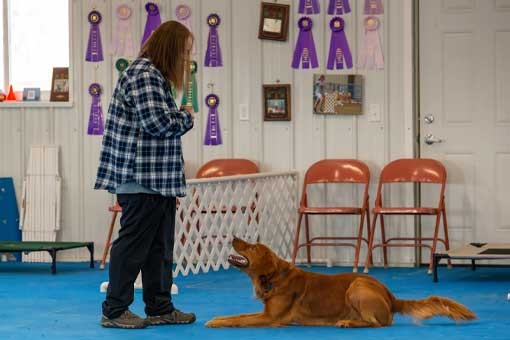
Honestly, that's exactly what we want in most of our training. We spend so much time building dogs who are active participants in the learning process. We celebrate dogs who experiment, who make choices, who stay engaged instead of shutting down. Those qualities create wonderful training partners, right up until the moment we ask them to do absolutely nothing.
Why Teaching Your Dog to Stay Still Feels Like a Different Game
From our perspective, stillness seems simple. Just stay there. Don't move. But from the dog's perspective, this is a completely different game than the one we've been playing all along.
Imagine you've spent months learning that the way to earn reinforcement is to keep trying. Every time you're unsure, you offer another behavior. Sit. Down. Eye contact. Spin. Paw. Back up. Surely one of those will be right. That strategy has worked for you every single time, so there's no reason to think it will stop working now.
Then one day your trainer goes quiet. Nothing happens. No marker, no information, no reinforcement. If you've never been taught that silence can actually mean, "You're doing exactly the right thing," why wouldn't you assume you should keep trying?
That's why so many smart, operant dogs begin cycling through behaviors when we ask for stillness. They're doing exactly what their learning history has taught them to do. When offering behaviors has consistently led to reinforcement, trying something new makes perfect sense. They're actively working to solve the problem because, up until this point, that's always been the winning strategy. Asking a dog to suddenly abandon a strategy that's always paid off, without first teaching them a new one, sets them up to guess rather than to understand.
Asking the Right Question About Dog Stillness Training
This is one of the biggest mindset shifts I hope people make when they're teaching stays or any kind of stillness. Instead of asking, "How do I stop my dog from moving?" I encourage people to ask, "Have I ever actually taught my dog that waiting is the correct answer?" Those are two very different questions, and they lead to two very different training plans.
The first question treats stillness as a problem to eliminate. It puts the dog in the position of doing something wrong, and it usually leads to corrections, frustration, or vague cues that don't actually communicate anything useful. The second question treats stillness as a skill to build, the same way we'd build any other behavior. It puts the responsibility on us to make the criteria clear and to reinforce the dog for getting it right.
Stillness isn't simply the absence of movement. It's a behavior that deserves to be taught just as thoughtfully as a retrieve, a heel position, or a nose touch. Dogs don't automatically understand that doing less can sometimes be exactly right. We have to show them that, the same way we show them everything else, with clear criteria, timely reinforcement, and plenty of repetition before we start raising expectations.
What Changes Once Your Dog Learns to Wait
Once a dog understands that waiting can be the correct answer, everything shifts. You start to see a dog who isn't desperately searching for the next answer. Instead, they're comfortable waiting for information. They understand that they don't have to fill every moment with movement, and they can pause, think, and simply be present with you.
This shows up everywhere, not just in formal stays. A dog who has learned to wait is easier to work with at the start line of an agility course, calmer in the crate between runs, and more settled at the dinner table. The skill generalizes because the underlying lesson generalizes: sometimes the right answer is to do nothing at all, and that's worth waiting for.
Ironically, teaching stillness doesn't make these dogs less enthusiastic. It makes them better learners, because now they know two equally important skills: when it's time to actively solve the training puzzle, and when the smartest thing they can do is settle in and wait for the next piece of information. That balance, knowing when to try and when to wait, is what separates a dog who's just fast from a dog who's truly thinking.
A Quick Gut Check for Your Own Training
Can your dog comfortably wait for five or ten seconds without offering another behavior, or do they immediately start trying to guess what comes next?
The answer tells you a lot, not about how obedient your dog is, but about the game they've learned to play. If your dog is still guessing, that's not a training failure. It just means stillness hasn't been taught yet, and now you know exactly where to start.
If you'd like some guidance as you teach this skill, check out my August class, Better Still: Stays Without Frustration. We'll work through the process together, helping your dog understand that stillness isn't just the absence of movement, but rather a skill that can be taught with the same clarity and confidence as any other behavior.
About the author

By accepting you will be accessing a service provided by a third-party external to https://www.fenzidogsportsacademy.com/


