AG105: Agility Foundations: Where Function and Fun Meet!
Course Details
We’ll focus on the kind of foundation work that top competitors in every sport spend an incredible amount of time on. These skills don’t appear all at once. They slowly weave their way into the full picture, creating dogs who are confident, thoughtful, and physically prepared for agility.
The class covers key agility foundations, including body awareness, commitment, jumping skills, contact foundations, and essential handling techniques.
Many of these skills are first taught without agility equipment. Training away from equipment keeps the process accessible, reduces physical impact, lowers the risk of accidental negative associations, and allows us to adjust our approach before adding complexity. When it’s time to transition to full equipment, the process is smoother and more enjoyable because the dog is simply generalizing known skills rather than learning everything at once.
These foundation skills carry beautifully throughout a dog’s entire career. The ease of setup allows for endless generalization, keeps skills sharp when equipment isn’t available, and makes this work especially valuable during winter months and for senior dogs who still love having a job.
Training will use short loops that incorporate stationing, transports, and varied reward strategies to build both sport-specific and supporting skills. Agility involves far more waiting and walking than running, and building these skills early creates dogs who are relaxed, connected, and easy to handle in and out of the ring.
Each week introduces new skills, with optional bonus exercises to help you grow them further through small sequences and added layers of generalization. These bonuses are there when you want them… now or later.
This is foundation training with long-term vision… designed to build confident dogs, thoughtful handlers, and agility skills you’ll be glad you invested in.
This class will have a Teaching Assistant (TA) available in the facebook discussion group to help the Bronze and Silver students! Directions for joining can be found in the classroom after you register.
Teaching approach:
Lectures will be released at the start of the week. Lectures are a written with video demos.
Feedback will be written with the use of still shots for clarity. In some cases voice over video may be used, I find in some situations it is helpful to explain in real time with the ability to slow down, rewind or stop video to help you see and understand a concept.
-increasing understanding of stationary behaviours
-growing targeting in motion behaviours
-continuing commitment
-rear cross foundations
-strengthening understanding of tip board criteria
Week 6:
-plank work for body awareness and confidence
-turns away on the flat and around an object
-increasing jump heights
-continuing to strengthening and grow understanding of tip board criteria -growing front cross and rear cross understanding
-continuing to strengthening contact end behaviours mat and 2o2o
Prerequisites and Equipment
In most cases a 10x10 space can be used, it is helpful to have a larger space available to grow the size of the loops as class progresses.
A cot, elevated is preferred
Rubber feet tub or equivalent
Platform, a cato or 2”X12” with a length that your dog can comfortable stand on
Tip board, home made, a Cato tip, or purchased one ( tip should be front to back not side to side) and dog should be able to stand with all four feet on the board
Mat, can be a puzzle mat or a cut piece of yoga mat
We want to be sure to introduce a bit of variety into our training. This adds a layer of distraction, and arousal and helps to further strengthen the behaviours we are building. This process is called generalizing the behaviour.
Dogs don’t naturally generalize well. For example, a behaviour that’s solid at home might completely fall apart when taken "on the road." To us, it’s just a new location—but to our dogs, everything has changed. They see, hear, and feel different things, and it can be overwhelming. As a result, they may act as if they’ve never done the behaviour before!
That’s why we need to introduce these changes gradually, helping our dogs learn to generalize behaviours in the presence of new distractions and environments.
Start Small!
The key is to add subtle changes—just enough for the dog to notice, but not so much that they can’t respond or complete the behaviour. So what kinds of things can we use to begin generalizing without overwhelming our dogs?
1. Rewards
For some dogs, changing the reward itself can introduce a new layer of arousal. For example, my big Lab is very excited by toys. When introducing a new behaviour, I start with food rewards. Once he shows understanding, I layer in toys as a higher-value reward. This helps me to layer arousal into the skill.
2. Equipment
We can use different objects to help generalize our body awareness exercises. For front feet up if you have been using a feed tub, go ahead and try using a step stool. If you’re working on jump behaviours, try adding variety by using different types of wings. If you don’t have access to other wing styles, get creative—drape a towel over them or tape some cardboard cutouts to change their appearance. You can also ask for a rear foot behaviour on different surfaces—use a Cato board instead of a plank, or even a curb at the park.
3. Location
This is a big one. A simple change of location can drastically alter the training picture for your dog. You don’t even need to leave your property for this one, even a different area of your own yard or house can present a new challenge.
When training off your property, start with quiet, low-distraction locations. A busy park is too much too soon—work up to those environments gradually. Find a quiet park, or a quiet corner of a park, go at off peak times, like early in the morning.
4. Noises
Many dogs find noises distracting. Try incorporating trial-like sounds during home training sessions to help your dog feel more comfortable with them in a less stressful setting. Common noises include:
Dogs barking or running through tunnels
Teeters banging
People talking, cheering, or using electronic timers
You can find these on Youtube!
Start at a low volume and gradually increase it. Don’t begin with a sound you know is especially challenging for your dog—ease into those later.
5. People
People can be another big distraction. Some dogs are fine with people off to the sides but find it difficult when someone is behind them. Others can’t resist someone sitting in a chair!
The level of distraction will determine placement. Start with people at a distance where your dog can still be successful, and slowly move them closer as tolerated.
6. Other Dogs
Other dogs can add significant pressure to a training scenario. If you have other dogs or a friend with dogs, having them crated nearby can introduce an additional layer of distraction. Again, pay attention to your dog’s comfort level and adjust distance accordingly. Better to start further away and have no problem than to start too close.
Expect to Take a Step Back
One of the most important things to remember: when you add a generalization layer, your dog may regress. That’s normal. Be prepared to take a step back in your training plan and rework those steps with the new challenge in place. Adjust your approach and help your dog rebuild confidence with the new layer you have added.
Let’s go ahead and plan a session using some of the material from lectures 1-4 with a layer of generalization! Plan to keep it easy, a short tight loop of a few skills that were strong for them. Even shifting to another room or stepping out to the yard counts!
Each week we will have a bonus generalization exercise to help remind you and encourage you to work on this very important piece of your training journey, this will help you to increase fluency in your behaviours, and help build resiliency.
For my demos I chose to change locations with in our home property
Leashing and Unleashing with noise:
You will see I choose barking and howling dogs for my background noise, and his first set of leash/unleash was not quite clean, he shifted his head around a bit during the process. I was going to go and lower the volume, but when the video I was playing switched to an ad, less exciting, I opted for heading straight into another rep, nice and clean. If I wanted to work with the barking dogs again, I would lower the volume.
Small loop with toy instead of dish/food:
Notice in this demo that his first rep he is easily able to trade out the toy, on the second rep there was a delay in dropping. To adapt I might have him reset calmly on the cot for a bit in between reps and build up to being able to do those reps back to back. These layers of generalization give us so much information about the fluency of our behaviours.
If you want to focus in on one single skill, maybe…
Cot work in a new location:
My demo here is a perfect example of things not going to plan and needing to step back. The morning prior to our session there was some blasting done close enough to really upset my little border collie. When I got her outside and on her cot it quickly became apparent that she wouldn’t be able to complete a loop, she was even struggling to settle on the cot. So our plan pivoted, and this became just a cot session. She needed a bit of extra support even for that to happen so I changed my position into a crouch to help her out.
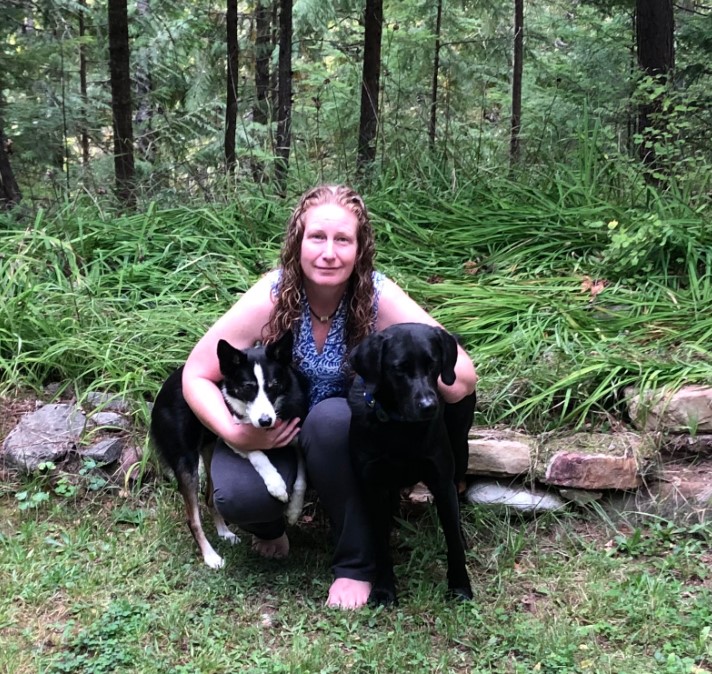 Guest Instructor: Laurie Huston


