FF185: Ready and Resilient: From Puppy to Awesome Adult
Course Details
The Ins and Outs of Raising an Awesome Dog
Puppyhood: A magical time where we can ensure that the puppy we have will grow up to be perfect in every way - or at least, that's what a lot of people tell you.
The reality is a lot messier. Puppies come with baggage, much of which you have no control over. 😕 You come with baggage, much of which you also have no control over. 😉
Puppyhood is a time when we balance moments of incredible frustration with moments of surpassing joy -- often one right after another. Getting through puppyhood is a lot like surfing a wave. The best things happen when you go with the flow. So how do you find the flow?
In this new course, Irith Bloom will discuss best practices for raising a puppy. She'll talk about how to set a solid foundation for the adult dog you want. She'll explain why she focuses on life skills with puppies. She'll also talk about fun ways to fit in things like tricks and obedience and set the stage for any sport you might want to do in the future.
If your goal is to raise an emotionally balanced dog who will be the companion of your dreams, this is the class for you!
Teaching Approach:
Lectures will be released once a week. Each week will feature more than one lecture. You can watch all the week’s lectures at once or space them out, as you prefer.
NOTE: Due to a temporary, medium-term medical issue with her voice, Irith will not be able to record as many lectures in video format as many of you have come to expect. She is hopeful that she will be able to provide many of the lectures in both video and written form, though.
Irith usually checks class forums morning and evening (Pacific time) each day. She endeavors to address all posts within about 18 hours, but it may occasionally take a little longer.
Since this is a new class, this syllabus is even more subject to change than Irith's usual syllabi (those of you who know Irith well know she often changes things around based on the needs of a particular class). With that said, below are some topics that will be addressed.
NOTE: The order of the syllabus as listed here does not necessarily mean topics will be addressed in that order. In fact, many of the topics listed will be woven into the entire course in a way that will help you learn how the ideas apply here, there, and everywhere. 😁
Management
What management means
When to use management
Useful management options for puppies and how to introduce them (including barriers and more)
Addressing Common Puppy Challenges
Housetraining
Bite inhibition
Appropriate chewing
Life Skills
Settling
Near a person
Away from a person
On-cue
Confinement training (for various types of confinement)
Arousal management
At-home skills (guests, human mealtimes, etc.)
Transport-related skills (car rides, etc.)
Choice-Related Skills
Opt-in/opt out signals
Preference signals (which toy, which direction, etc.)
Setting up puppies to make choices we can live with
Socialization
What socialization is (and isn't)
When and how to socialize
Best practices for socialization
Obedience/Tricks
Benefits of tricks and obedience
Teaching common obedience skills and tricks
Leash/walking skills
Building a Strong Bond
Communication
Play and other shared fun
Other ways to encourage bonding
Building Independence
Promoting a sense of safety
Encouraging independent activities
Strengthening problem-solving skills
Preparing Your Puppy for Sports Goals
Building a strong foundation for any sport
Reviewing your goals
Specific, age-appropriate training for your preferred sport(s)*
* This will be customized for each training team through forum discussions.
Again, the above syllabus is subject to change to accommodate specific class needs.
Prerequisites and Equipment
There are no formal prerequisites for the course – not even having a puppy! I’m happy to have you work through the course tasks with your baby or adolescent dog, cat, horse, parrot, etc., as well as your adult dog.
With that said, this course will focus on working with young puppies and adolescent dogs.
NOTE: Consider a vet check before starting this or any other training!
Hi everyone! I'm Irith Bloom, and this is Fenzi Dog Sports Academy BH245: Getting Geeky About Behavior Change.
Teaching Arousal Management, Part One
In this lecture, we're going to get practical again and think about teaching arousal management.
Arousal Management is a Skill
I want to emphasize that arousal management is a skill. Some animals are inherently better at it than others. Some animals struggle with it more. But it is a skill. It can be taught, it can be strengthened. It can be improved upon.
Why work on arousal management?
In case any of you are wondering why you should work on this, it's because arousal affects learning and behavior.
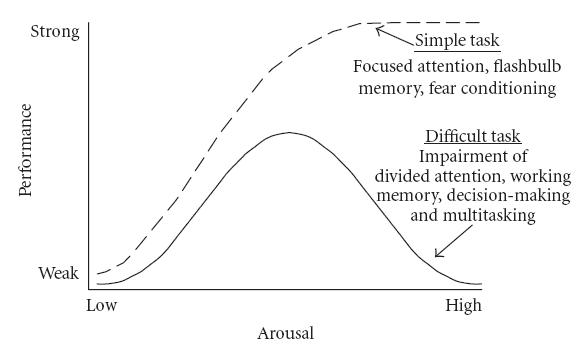
The following is something called the Yerkes-Dodson curve.
I won't go into an in-depth analysis of what is shown above right now -- that is in its own lecture -- but here's what the curve shows us that matters of the sake of this discussion:
There is evidence from years of research dating back to 1908 that if arousal is too high, certain kinds of learning - which are usually the kinds we don't want - are more likely.
Also, the kind of helpful learning that we do want can be less likely.
As a result, in higher states of arousal, you may find that an animal chooses behaviors that you wish they wouldn't choose.
On the other hand, in a lower, more -ppropriate-for-the-task state of arousal, they might choose the behavior that you've been working on as a nice substitute for the less than ideal (to us) behavior.
The bottom line is that arousal affects our ability to think;. It affects cognition, which means it affects learning and it affects behavior. All of this means that, managing arousal is an important piece of getting the behavior that we'd like to see and helping an animal -- especially a young one like a puppy -- navigate the world successfully.
Three Options
I'll be discussing three options for teaching arousal management, in this lecture and the two after it. Note that these are far from the only three options. They're probably not even the three best options, but they're three options that I use a lot. Here's the list:
Off-Switch Game
Play with Deliberate Ups and Downs (in arousal)
Self-interruption of Partner Play
In this lecture, I will focus in on the Off-Switch Game. The play topics, which will each get their own lecture, will be coming up next.
The Off-Switch Game
NOTE: There are lots of variations of off-switch games. Mine is not the only one, and I do not mean to suggest it is the best one, either.
The Off-Switch Game, as I teach it, is a game where the handler moves at a level that the animal can handle, then stops and then cues a stationary behavior of some kind. Note that:
The stationary behavior is reinforced every time.
You use the same stationary behavior every time, unless the animal indicates to you that they prefer a different stationary behavior, in which case you can switch to the one that they prefer.
Eventually, the animal starts to learn to anticipate the cue and and goes into the stationary behavior before the cue happens.
This is one of the goals - it's a kind of cue transfer where the animal learns that when you stop, that's the cue to go into the stationary behavior.
NOTE: If your puppy doesn't have a stationary behavior on cue yet, that's fine! Most puppies will at least pause in a stand when you turn towards them. Feed for that (and feed low so they keep all four paws on the ground).
This game teaches two things.
1. First of all, it teaches a default behavior (or a new habit, if you will) around movement. In other words, the default goes from 'chase the person around and then jump on them if they stop,' to 'chase the person around and then stop when they stop' - which I personally think is a good thing. Hopefully you agree! 😉
2. Also, when this is done at the right level, so that the handler is not pushing the animal too hard, it helps the animal to learn to manage their arousal.
As The animal gets better at this, you can start to increase the difficulty by making the movement more exciting or having the session last longer. All of that will help develop their arousal-management skill.
Video Examples
Let's take a look at two examples of this game. Unfortunately, I only have video of adult dogs doing this,* but the videos demonstrate the concept clearly.
*NOTE: I am hoping some of you will be willing to share your video with puppies for future use in classes and presentations. 😁
The first video in particular will be a good guideline for many of you right now, since puppies often need to start the game in a very easy way.
This video shows a beginner dog. This particular dog does a thing where he nips his people's rear ends when they move away from him. That is obviously uncomfortable and a bit of a problem for the humans. 😕
For that reason, we are working on teaching the dog to stop when the humans stop.
We are hoping that will also help him be a little calmer around movement in general, because we're stretching his arousal around that type of stimulus. Even if the behavior doesn't generalize to other types of movement, though, at least the humans will be able to stand still to stop the jump-and-nip routine.
For this dog, any movement at all increases his level of arousal, so we start at a very low level of arousal. Note that there is no sound on this video. Let's watch!
NOTE: I recommend you watch once through, then read my notes below, and then watch again. The video is very short.
You can see the human walk away from the dog. You can see she's walking very calmly. He follows her, she turns, she cues him. I believe she actually cued him to sit and he may have dropped into a down there. She's asking me a question and I am saying it doesn't matter that he went into a down. If that's the behavior he wants, that's fine.
And here you can see he went into a down very quickly, which is really nice.
Now she's going to walk away from him again. And that time, I don't know if you saw, her finger pointed down. So she gave him a cue for the down.
A little bit of a lip lick there. He's not quite sure what's going on. She and I are talking, which is not his favorite thing.
And finally there is a nice, low-latency down.
We're going to end the session here because I usually keep Off-Switch Game sessions to one minute or less. There's a lot of cumulative arousal that happens in these sessions. Keeping the sessions to one minute and making sure that the animal stays calm the whole time is crucial to success.
The other note that I will add about this is I don't care what the stationary behavior is. This dog happens to do a down, which is totally fine. Whatever the stationary behavior is, as long as it works for you and it works for the animal, that is fine.
From here, what the client would do is she would start to increase the pace of her movement; the next video gives you a sample of what that might look like.
NOTE: I want to say a huge thank you so much to these clients and the ones in the second video for allowing me to use these, which were taken during zoom sessions, for presentations. They are truly stellar, wonderful human beings for allowing me to use the material in this way. This note applies to everyone who has allowed me to share video of them, of course. 🙂
This next video shows a dog who is more intermediate. The dog has learned the game and is getting better at it. Given her level of understanding of the game, we are starting to push the speed a little bit.
There are a couple things I want to point out before you watch.
One is the dog's body language. Towards the one minute mark, you're going to see the dog's body language start to get more and more aroused. There are definite signs of arousal. I want you to watch for those, because you're going to need to watch your own animal for those.
I also need to warn you that there's a little bit of shaky cam, so hopefully it won't make you too crazy.
All right, let's watch. (Again, I recommend you watch once through and then read my notes below the video.)
So you can see the person is moving away. The dog is very attentive. You can see she's already pretty excited. He asks her for a stationary behavior. He feeds.
Now he's going to walk away. She doesn't follow because I think she thinks she's in a stay. And then she races over to him, but she's not nipping at him (which is what she typically did before we started working on this game). He stops, she stops. She gets a treat.
Now he's going to start picking up the pace. And when he stops, she stops and she gets a treat.
And now he's going to pick up the pace even more. And look at that: She went into the down before even cued!
Now, here is where her arousal starts to get too high. Watch her tail. So she does stop successfully, and we end the session right there.
Helpful Tip: With this particular dog, before we played the Off-Switch Game, we practiced 'down' a little bit because that put 'down' in the front of her mind, which made the task a little easier for her. We all agreed that down would be a suitable behavior for this scenario because she's also one of these dogs who tends to nip. (She doesn't nip at rear ends. She grabs at clothing.)
You can see how far she's come in just a little bit of work. This is either her second or third Off-Switch Game session. I suspect she just needed to know what to do instead of nipping.
So that is what the Off-Switch Game looks like.
Quick Summary
Remember, the focus of the Off-Switch Game game (as I teach it) is twofold:
Teach a stationary behavior for the animal to do as soon as the humans stop and stand still.
Flex the animals "arousal management muscle" so they can learn to deal with their impulses in a more productive way.
One More Tip: Remember the Yerkes-Dodson curve above? What we are doing here is a difficult task. That means the key to success is working at a level where the animal can still think through the problem. In other words...
Start out super-easy, with slow, boring movement.
Build up in tiny increments/steps to faster or more exciting movement.
If the animal starts to forget what to do, take a break and then make things easier again in the next session.
Key Takeaways
Here are the key takeaways from this lecture:
Arousal management is a skill.
Like all skills, that means it can be worked on.
You can improve the skill with practice.
There are a lot of ways to work on enhancing arousal management, not just the three that I mentioned above (and that we will cover in this and then next two lectures). If you find something else that achieves the goal, by all means, please use it for arousal management practice.
Keep sessions short!
Cumulative stress and cumulative arousal can derail your practice.
Short sessions are a great way to start.
Make sure that you're working at the level that the animal can handle.
Constantly watch their body language to see whether they're amping up or not.
When you practice at the right level in short enough sessions, you may see two different benefits (and possibly others as well).
One is that the animal is better able to manage their arousal level, so they don't amp up as fast or they don't amp up as high.
The other is that the animal may be able to think through higher levels of arousal, so they're more excited and yet they're still able to respond to cues and so on.
Test to see if what you're doing is working.
The best way to test is by varying cues or asking the animal to do something that is unexpected in that context and therefore requires them to stop and think.
There are no scheduled sessions for this class at this time. We update our schedule frequently, so please
subscribe to our mailing list for notifications.
Registration opens at 11:00am Pacific Time.
SILVER LEVEL Testing Project for February 2026 - In this session students will be permitted to submit ONE 90 second video per week when registered at the silver level. All "your dog" specific questions must be accompanied by video so the instructor can assess video and questions together. Silver students may also ask generic questions and participate in discussion forum threads.
 Instructor: Irith Bloom