BH230: Control Unleashed - A Deep Dive into Pattern Games
Course Details
Discover why Control Unleashed Pattern Games are a top choice for helping dogs navigate our crazy world!
Patterns are a simple tool to help with a number of challenges:
Leash reactivity
Distraction or arousal in trial environments
Poor manners
Lack of engagement
Stressing up or down
Excitability
Barking, pulling, lunging on walks or at guests
Frenzied behavior upon arrival to a new place
And more!
They’re also a great way to be proactive in training your sports dog or family dog. Puppies and adolescents will benefit greatly from Control Unleashed Patterns!
This class takes you from the most basic pattern up to the most complicated, allowing you:
To try out each pattern to determine the best ones for you and your dog.
Learn how to build routines that put different patterns together based on your dog’s needs.
Incorporate patterns into your sports training.
And generalize them in preparation for using them in real-life situations.
And for those of you who are dog trainers, this class can give you a number of tools to help your clients, as well as 6 CEUs!
Teaching Approach:
Kim releases lectures every few days based on the classroom progress. Skill-based lectures will include written text, a tutorial video, step-by-step instructions, and additional demonstration videos.
Feedback is unique to each individual student and their needs. The feedback is written and may include timestamps or screenshots to point out specific points in the video. Focus is placed not just on the skill itself, but also the handler’s mechanics and the dog’s physical and emotional comfort level to ensure the most progress can be made. Recommended next steps are often included.
This class will have a Certified Control Unleashed Instructor, Nicole DuFresne, as the TA for the bronze and silver levels. In addition, Kim offers occasional Zoom calls for ALL students in this class to attend and engage in!
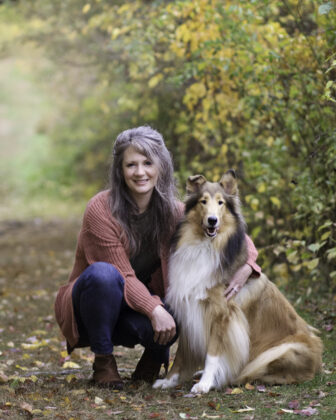
Kim Palermo CPDT-KA (she/her) is a Certified Control Unleashed Instructor and ACE (Animal Centred Education) Practitioner. She specializes in teaching Control Unleashed and ACE Free Work with private clients, teaches a high volume of in-person CU classes, and incorporates CU into all of her membership-style group pet dog classes for her dog training business, BlueDog, located north of Boston...(Click here for full instructor bio)
Now that we’ve discussed the many benefits of patterns for our dogs, let’s get started on teaching our first one!
The Up Down Game is the most basic of our patterns, but don’t let that fool you. This skill is incredibly powerful and valuable to both you and your dog. And for now, we’ll use it to teach our dogs the concept of a pattern, and how they can have agency and control in the game.
In the most simplest form, the Up Down Game is:
You place a treat on the ground in front of you - your dog eats the treat - they look up at you - you place another treat on the ground - repeat!
Let’s see how that looks in action:
Now, before you dive right in, let’s break things down a bit:
Using Targets
I like to use targets for this game. We don’t always have to have targets with us, but they’re certainly going to help. For one, they provide predictability for our dogs in that they can rely on the fact that the treat will always be on the target. No need to search for it or worry where it is. For a dog who is especially foodie, not knowing where the reward will be can cause all sorts of conflict. Or for a dog who is not particularly food motivated, having to put effort into finding the treat may not be worth the trouble.
It also keeps us, the handlers, steady and still. If we’re placing food on a target, we’re less likely to fidget our feet and body too much. It’s essentially a station for us! Once again, we’re building on the predictability of the pattern.
And my favorite reason for using targets is that we build value for those targets, and they can very quickly become portable happy feelings! If we can build value for the target simply by playing patterns with it, we can then use that value as a way to bring along that positive CER (conditioned emotional response) when we begin to bring our patterns out into the real world. My dogs love when I pull out targets!
To Mark or Not to Mark
I’m going to boldly state that I see no reason why you wouldn’t use a marker here such as a verbal marker, clicker, or mouth click unless your dog has aversive feelings toward a marker. It’s going to provide your dog with a lot of clarity on what the criteria is for the next rep! However, if you don’t feel comfortable using a marker, let’s discuss - I understand there are reasons for not using them. I am also happy to help you build your marking skills while in this class.
Considering Your Mechanics
I am a stickler for clean mechanics. I find so much joy in making adjustments to what I’m doing and then watching those changes improve my dog’s learning process. And I can help you do the same! What I mean by clean mechanics is how we’re holding ourselves and our hands, how we’re placing the food down, etc.
I like to keep my hand in a neutral position away from my treat pouch. With this game in particular, since we’re trying to build eye contact, we’re going to be competing with the dog’s need to look at the food source. Hovering our hand by our pouch will only bring attention to it. You’ll either want to reach into your pouch after your click, or have a handful of treats in your hand behind your back if your dog is really fast (with the goal of slowing that down - but one step at a time!).
Here’s a little on our neutral position:
Alright, all that said, here’s your tutorial video for the Up Down Game!
And here are your step-by-step instructions:
With your dog standing in front of you, place a treat on a target on the ground in front of you.
Allow your dog to eat the treat.
After eating the treat, when your dog gives you eye contact, mark.
Place another treat on the target.
Repeat!
Troubleshooting:
Easy, right? Well, not always. If your dog doesn’t figure out that you’re looking for eye contact relatively quickly and without frustration, you can try the following - (OR you can post your video for my best suggestion on what to try!).
Shape the behavior by clicking first just for your dog finishing the treat, and then continue to click incremental behaviors of your dog raising their head until you ultimately get eye contact.
Remove your treat pouch if your dog is looking at the food source rather than your eyes.
Sit on the ground or on a chair so that your “eyes” are closer to your dog.
Another common challenge I see is an operant dog trying to do something with the target! I have two suggestions to work through that:
Mark and treat for your dog simply standing near the target but not interacting with it. Eventually shape for eye contact, making sure not to click for any behaviors that indicate interaction with the target.
Remove the target, teach the concept of the game, and then reintroduce the target!
Do We Really Need Eye Contact?
Nope! What we are looking for is a “start button behavior” - any behavior that our dog can offer that will cue us to perform the next rep. Ultimately, eye contact or orientation to us is going to work best for our patterns and it’s what I recommend. We can save the “other” start button behaviors like a chin rest or targeting for more complex skills down the road.
That said, there are certainly dogs who are either emotionally uncomfortable with direct eye contact, or physically strained by raising their heads high enough to find our eyes. In that case, I’ll simply change my criterion to looking at my chest, or even looking anywhere above my hips. If this is your dog, let’s discuss and determine the option for them.
Alright, let’s get training! Go ahead and try this out, post your videos for feedback, and off we go!!!
A sampling of what prior students have said about this course ...
Kim was amazing! The clarity of the lectures, the video tutorials, and the video examples for teaching the patterns were easy to follow and understand. Kim's feedback to the gold students was exceptional. She met each person and dog where they were at so that they could make progress in the areas they most needed. Loved Kim's teaching style and dedication!
Kim is great! Explanations are clear and I really appreciate her consistent reminders about appropriate arousal levels while we are playing the pattern games with our dogs (as well as not pushing our dogs into more distracting environments too quickly). I am definitely looking forward to the next CU course!
Kim’s feedback to Gold students was very good at adding depth and context for those following at Bronze. I learned a lot from this course and loved Kim’s teaching style. Highly recommended!
For me, it was eye opening, because in previous courses about CU pattern games I didn't find so good explanation about progress and variations of the games. Kim's coaching was detailed, fast and clear. Really good course.
Kim has done an outstanding job with this class. She’s a highly knowledgeable dog trainer who communicates clearly and effectively through written lectures, videos, and thoughtful feedback. She's also incredibly supportive and kind, which makes a big difference when working with dogs that present challenges. Her approach has helped me see and appreciate the strengths in my dog, something that’s often overlooked by others. I would gladly take another class with her in the future.
I have been doing CU patterns for years, but I learn something new every time I revisit them. I really enjoyed this deep dive to fine tune some skills and build up some others. Kim's feedback is specific and helpful. Lots of geekery can be had here!
The balance of videos and clear explanation was excellent - I appreciated having notes to refer to. Thanks Kim - It is making a real difference to my environmentally aware terrier - we are finally able to play brief sessions on the patio after 6 weeks.
The course material is incredibly helpful for dogs with big feelings—it provides clear, tangible, and effective strategies that help both the dog and the handler navigate challenging moments. Working with big feelings dogs can be hard, and this class offers tools that truly make a difference. Beyond the material itself, the instructor is kind, encouraging, and always helpful. Her written lectures are clear and well-organized, and the accompanying videos are extremely instructive.
Registration
There are no scheduled sessions for this class at this time. We update our schedule frequently, so please
subscribe to our mailing list for notifications.
 Instructor: Kim Palermo


