logo

  • Log In
  • Lectures
  • Homework Forum
  • Discussion Forum
  • About Us
  • Calendar
  • Faculty & Staff
  • instagram-icon
  • facebook-icon
  • twitter-icon
  • Courses
    • Schedule
    • By Discipline
    • By Instructor
    • Prerequisites
    • Self-Study
    • Scholarships
    • Gift Certificates
  • Webinars
    • Schedule
    • FAQ
  • Workshops
    • Schedule
    • FAQ
    • Gift Certificates
  • On Demand
    • Pet Dog Presentations
    • Pet Professionals Presentations
    • Self-Study Courses
  • Special Links
    • Podcast
    • Blog
    • Fenzi TEAM Titles
    • Trainer Certificates
    • Private Lessons
    • Other Free Stuff!
    • Swag
  • Conferences
    • CANIS Conference Registration - Attend In-Person
    • CANIS Conference Registration - Virtual Attendance
  • Contact
    • Course FAQ
    • Webinar FAQ
    • Workshop FAQ
    • Testimonials
    • Contact Help
  • Courses
    • Schedule
    • By Discipline
    • By Instructor
    • Prerequisites
    • Self-Study
    • Scholarships
    • Gift Certificates
  • Webinars
    • Schedule
    • FAQ
  • Workshops
    • Schedule
    • FAQ
    • Gift Certificates
  • On Demand
    • Pet Dog Presentations
    • Pet Professionals Presentations
    • Self-Study Courses
  • Special Links
    • Podcast
    • Blog
    • Fenzi TEAM Titles
    • Trainer Certificates
    • Private Lessons
    • Other Free Stuff!
    • Swag
  • Conferences
    • CANIS Conference Registration - Attend In-Person
    • CANIS Conference Registration - Virtual Attendance
  • Contact
    • Course FAQ
    • Webinar FAQ
    • Workshop FAQ
    • Testimonials
    • Contact Help

BH110: Dealing with the Bogeyman: Helping Reactive and Fearful Dogs - The Play Way!

  • Overview
  • Syllabus
  • Prerequisites & Supplies
  • Sample Lecture
  • Testimonials & Reviews
    • Registration
      Apply for a scholarship

  • See Also
  • All Classes
  • All Workshops

BH110: Dealing with the Bogeyman: Helping Reactive and Fearful Dogs - The Play Way!

Details
Category: Course Descriptions

Course Details

This is Amy's signature Play Way class!

If your dog feels fine at home but struggles once the world gets involved, you are not alone. Barking or lunging on walks, freezing or scanning in new places, or just seeming generally stressed are all signs that your dog is overwhelmed and needs help.

The Play Way is my signature class and the work I am best known for. I developed it through years of working with fearful, reactive, and sensitive dogs, and with the people who love them and who are stressed themselves! It uses Therapeutic Social Play to help dogs learn how to take in their world and know that it is safe, rather than starting from a place of escape or defense. Play Way builds your dog's optimism, and the relaxation that supports it.

At its heart, this class is about learning to listen. Play is how we learn to hear what a dog is saying, how to respond clearly, and how to share an interaction without taking over. When that kind of play is easy and available, with your dog leading, you can then feel very easily when things are going well. When they are not, the change in their play tells you something important has shifted, often before bigger behaviors show up.

In this class, play is not about distraction or getting dogs hyped up. It is a calm, low-pressure, silly interaction that helps dogs stay under threshold, notice what is happening around them, and recover more easily. Over time, many dogs move through familiar challenges like walks, training, or new environments with less tension and more curiosity.

For the people, this class offers something just as important. You will learn some of the most effective entry points for creating change for your dog, by understanding where they are emotionally and what they can handle in that moment. Instead of guessing or reacting after things fall apart, you will have clearer information and more options.

This course is designed for pet dogs navigating everyday challenges, sport and performance dogs who need a solid emotional foundation, and everyone in between. If you have heard about the Play Way and wondered how getting silly can be therapeutic, this is that class. And yes, play is magic.

Gold level participants will be personally coached on how to work through their individual issues. You'll spend the first half of class learning or improving your therapeutic social play so he can relax and have fun, and then for the remainder of the class, you'll learn how to apply that to your dog's situation through the skills of Look and Dismiss. Your dog will learn to look at his triggers in a new way, and for as long as he wants, which sets this system apart! This level is ideal if you need plenty of support getting a play relationship going, and you will learn play vocabulary, the structure of conversation, how to take turns, and when to let your dog lead. 

To gain the most value from this class, all students should commit the time to reading the advice given to several Gold level students throughout the class in order to create a workable plan for their own dogs. Many times, the gem you need for your own dog will be in my response to a different student, and I do write gold feedback with the entire class in mind.

IMPORTANT INFORMATION, please read all details:

This class has special enrollment for gold. To get these instructions, you must email Dr. Cook and stipulate that you understand that the class focuses on social play as therapy, and that the issue you are hoping to address is not one involving aggression toward the owner or other family members, in-home dog-dog aggression issues, noise sensitivity, or resource guarding. The enrollment request should only be made between terms, so after the currently-running term ends (usually the 15th), but before the 22nd, when registration opens, you should email rover@sonic.net and request enrollment information, stating that you've read the above.

Your request windows:
March 14th to March 21st, since enrollment will open on March 22nd for the April term
July 14 to July 21st for the August term
November 14th to November 21st for the December term.

Enrollment opens on the 22nd, and the spots will sell out, so get your instructions by the 21st, and be ready when the doors open.
You'll be given special link to register with, but that does not guarantee you a spot in the class.  It may narrow the pool of potential students, but you still must be there when enrollment opens to try for a gold spot, and they sell out quickly. Having the link does not mean you have a spot. 

If you have a question about the class and whether you should take it, you may email any time with those questions.  Enrollment requests, however, should happen only in the above request windows.

NOTE: This course is for dogs who either shut down or stress up when out and about or who have a specific stress issue that affects an aspect of their lives. If your dog only has issues in the performance ring, the Ring Confidence class the one you want, rather than this one! Feel free to send an email to help@fenziacademy.com  for clarification on which class is the best option for you.


Teaching Approach

This class is forum-focused.  Lectures will be released in blocks of related information, front-loaded more in the beginning of class than at the end, rather than weekly.  From there, all guidance is in the gold and silver forums, and students are strongly encouraged to follow along with the teaching there. All modifications and all further development of the material happens there, and as this is a concept-heavy class, that is where your essential learning is likely to be.  All teaching in this class is written or visual, and there is no audio or voice-over material. Since the skills in this class are not straightforward, much is explained through analogy, and trial and error (though there are no errors!) is emphasized.  We learn by doing, and then by doing again, and then again, making intuitive adjustments along the way (with my help and analysis!). This is not a typical class where skill A is followed by skill B, so know ahead of time that the learning will not be linear, nor identical for everyone, nor recipe-based.  We deal in concepts that require exploration and thought and independent application. 

This class will have a Teaching Assistant (TA) available in the facebook discussion group to help the Bronze and Silver students! Directions for joining can be found in the classroom after you register.
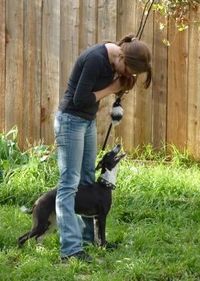
Amy Cook, PhDInstructor: Amy Cook, PhD

Amy Cook, Ph.D. (she/her) has been training dogs for over 30 years, and through Full Circle Dog Training and Play Way Dogs in Oakland, CA, has been specializing in the rehabilitation of shy and fearful dogs for 20 years. She is a Certified Dog Behavior Consultant through the IAABC, a longstanding ...(Click here for full bio and to view Amy's upcoming courses)

Syllabus

View Full Syllabus

In this course you will get individual attention as a Gold participant, with material given that directly supports you in learning to play socially. We start out with learning play vocabulary while we support your dog with food for following along, and then we put it together bit by bit. Your coaching will be tailored to what your dog says and to what your abilities are, and we'll build an interaction that you both enjoy and feel supported by. 

Through lecture materials, you will learn:

--How to identify stress in your dog
--About relaxed play, and its important role in the rehabilitation of stress and fear
--Why letting dogs look at triggers instead of asking them to look at them is different
--Social play, food or toys: which one should you use and when?
--Threshold management and what trigger stacking is
--How far away from your trigger is enough? How can you be sure?
--Classical conditioning applications, and why small mistakes can make a big difference

Coaching may consist of:

--Establishing a play dynamic between the dog and handler team that is rehab-supportive
--Taking that interaction on field trips, and seeing where your dog is comfortable enough to play
--Introducing triggers at manageable and appropriate levels
--Learning how to read your dog so you know what to do when

Lectures are put up in blocks of several lectures each, covering the above content, and are released early in the class so you can get all the elements in mind.  Later, we discuss what to do for sudden environmental contrast issues, and concepts for working with dogs when you can't reduce threshold as far as you'd prefer. The lectures will give you general material to think about in learning about fear, reactivity and stress reduction approaches in dogs, and coaching will make sure your team has the practical skills to continue working after the class is over. 

This is your chance to get one-on-one attention for you and your dog! Come, join us and see what the buzz about "The Play Way" is all about!

Prerequisites & Supplies

View all Prerequisites & Supplies

There are no prerequisites and we start from scratch, but if you want to learn some general play skills or expand your vocabulary outside of play therapy, Denise Fenzi's play class might be of interest, at your discretion.  It is available for purchase here as self-study.  Rest assured that we'll definitely be starting at the beginning in this class and building your own special play language together, one that can be used to reduce stress and build your sensitivity!

Sample Lecture

More

Look and Dismiss (or why we don't teach dogs to look at things!)

It can be difficult to know what your dog is really feeling. We only have behavior to look at, and it isn't always clear to us, especially in dogs that have had a lot of experience in training. Sometimes dogs are obvious in their signals, but just as often this isn't the case, and we have to look for more subtle signs that confirm for us whether our dogs are concerned or really feeling ok about what's going on around them.  One thing we use in this class is the quality of their play. The other thing we use is how much looking away from you they are doing.

The extent to which your dog has to look at things is a direct way to measure how they're feeling about those things. Looking at something you're concerned with is a natural behavior; indeed it's quite difficult to teach someone *not* to look at something they're concerned about!

So this natural signal is one we can use! Your dog will just do it because she has to, and you can use how much she has to as a gauge for how she's feeling, and you can use how much her need to look is reducing as a gauge for how she's changing her feelings.

When your dog no longer looks at his trigger any more than a very occasional glance, we can say that theyre "dismissing" it. It's not a big feature in their mind any longer, and they are concentrating on their time with you.  Over time, this process will happen more quickly, and they will be able to "look and dismiss" with just a glance or two, or one longer look, and just be done with it! This is your ultimate goal. Imagine your dog just looking at a stranger, another dog, or a new object and then being done with it entirely, preferring to move onto the fun things you're offering!

There are two things you can do to muddy this signal, though:

Don't be so amazingly awesome that it's too hard to look away from you! As you play, you want to make sure that you're not so magnetizing that looking away from you is difficult ("OMG SHE HAS HOTDOGS, MY FAVORITE!!!").  If you do that as a habit, you might correspondingly pick a trigger strength that is too high (because your dog isn't looking away, after all) and then you have a big problem.  If you're easy enough to look away from, you'll keep your natural signal intact, and then when that signal tells you (by its absence) that there's no lingering concerns, you can bring in the more exciting play, now confident that you're not obliterating that signal.

Don't teach your dog TO look at something, on purpose.  When you do that, you have interfered with it being a natural signal, and will have some difficulty knowing whether your dog is looking because he needs to, or is looking because he's been taught to and wants the reward that it connected to him performing that behavior.  You may not get that reduction you're looking for, and it will be more difficult for you to know if things are improving. 

If you've already taught this, you can unteach it, but it'll just take some time.  You'll want to reward them for checking back with you, but then reward for continued looking at you to counteract the back and forth they may be offering. You'll want to do this only in absence of a stress trigger though, so just use regular distractions for this work. 

Lastly, you don't want to interrupt them if they do look away by calling their name or saying "uh-uh" or touching them or anything else that communicates that they should turn to you instead.  Let that be their choice, and their natural signal to you. The more you teach them to do it on purpose, or the more you interrupt them displaying that signal, the less useful it will be to you.

And, as always, if you're concerned that your dog looking at something will upset him, you're too close, or the trigger is too intense in some other way.  Back up, make it easier, and let them look!

Testimonials & Reviews

Read All Testimonials

A sampling of what prior students have said about this course...

I am going to miss this class! I feel I got to know the other participants, their dogs and their struggles. Amy's lecture materials and basic premises were reflected again and again in the homework forum. The concepts of behavioral change just aren't easy to grasp. We have been working for years now in our attempts to affect change in our easily aroused Aussie. I felt I was quite familiar with the concept of "threshold" as an example. In this class I feel I am finally starting to get it! Amy's analogy of the traffic signal (green/yellow/orange/red) when talking about thresholds has been invaluable. I use it daily. Thank you, Amy, for your thoughtful input and your support throughout this class. Sandy H  


 The "Dealing with the Bogeyman Course" is extremely instructive. All the "exercises" suggested during the course are aimed at helping dogs overcome their fear and they really work. The most valuable thing, to me, was the reminder about keeping under threshold. Also extremely valuable was that I was able to arm myself with good information to be able to tell people that I knew what I was doing when I "comforted" my scared young dog instead of "making her snap out of it". Sarah G


Bogeyman has given us a renewed focus and energy for our obedience competition. Amy has such a great knowledge and ideas to help you work through any type of issue. You could see the dogs transform over the course of the class, as well as a plan for moving forward after the class. Melissa C


While working under Amy's guidance, I started to feel more confident about any potential triggers that we could come across. We started to enjoy our relaxed (!) walks together opposed to my dog being frantic looking for things to sniff, stare or pounce at. We learned so much in this class and will continue to practice our skills and grow confidence and appropriate behavior. Thank you, Amy! Anya K. 


 I am very pleased with the value of my course Dealing with the Bogeyman. I felt like I was achieving something each training session. What a relief to finally have someone see what I see, and give me a unique training plan. Cheers Tracey M and Wallace


Bogeyman is the approach to helping fearful dogs that I have been searching for. It isn't just about managing your dog, Amy's methods enable your dog to get comfortable with their triggers and learn for themselves that it is no big deal, Stacey M.


I am amazed at how much I have learned in this class. I now know what my dog's comfortable with when interacting and playing with me, and I can better assess her stress level around things that scare her (and I don't need food to do this!). I am understanding my dog better and I am already seeing signs that the class has helped her be less worried around her triggers. Amy is nothing short of amazing -- her analyses of her student's videos, her responses to their questions, and her encouragement and support are beyond what you would expect for an online course -- she really wants her students to succeed (and they are doing just that!) I am definitely going to take this class again, thanks Amy!


I took Amy Cook's Bogeyman Course as a Bronze, and I learned so much from Amy's lectures and watching the other students. We definitely hope to return as a gold or silver. My dog Daisy and I have been working on her dog reactivity for 4 years. Using other protocols, we had made a lot of progress but had reached a plateau. The main takeaway I got from Bogeyman was my change in attitude toward my dog. I have tried to control/treat her "problem" for a long time. After this class, we have shifted to having fun (PLAY!) and accepting her emotions as just that -- her emotions. Instead of controlling her, we now use play as a check in to see if she is okay with the world at that moment. We find this MUCH more effective than trying to prevent an outburst. Just this morning, I made an error in judgement and instead of beating myself for the rest of the walk, I focused first on soothing Daisy and then bringing her energy back to light and fun with play, and it worked! In the past, the incident would have colored the rest of the walk -- if not my whole day. I found this class transformative for both myself and Daisy. I can't recommend it more highly. Linda F and Miss Daisy

Registration

Next session starts: April 1, 2026
Registration starts: March 22, 2026
Registration ends: April 15, 2026

Registration opens at 10:00am Pacific Time.

To get a Gold working spot in this class, you need to first contact Dr. Cook and use the directions above.  There will be a special gold level registration page given to people cleared to take the class.   

BH110 Subscriptions


Silver

Bronze
Tuition $ 130.00 $ 65.00
Enrollment Limits 40 Unlimited
Access all course lectures and materials ✔ ✔
Access to discussion and homework forums ✔ ✔
Read all posted questions and answers ✔ ✔
Watch all posted videos ✔ ✔
Post general questions to Discussion forum ✔ ✖
Post dog specific questions With video only ✖
Post videos Up to 2 ✖
Receive instructor feedback on
  • Questions
  • All videos
✖

Find more details, refund policies and answers to common questions in the Help center.


  • Prev
  • Next
  • FDSA
    • About Us
    • What Do We Teach?
    • Faculty & Staff
    • Testimonials
    • Privacy Policy
  • Student Resources
    • Calendar
    • Scholarships
    • Gift Certificates
    • Swag
    • Trainer Certificates
  • Courses
    • Class Schedules
    • By Instructor
    • By Discipline
    • Prerequisites
    • Self Study
  • Webinars
    • Schedule
    • Webinar Courses
    • Register
  • More Learning
    • Podcast
    • Blog
    • Puppy Book
    • Private Lessons
    • Team
  • Help!
    • Getting Started
    • Enrolled Students
    • Video & Images
    • Webinars

Copyright © Fenzi Dog Sports Academy and individual instructors.

Technical support - send email to help@fenziacademy.com

Connect with us! facebook-icon email-icon instagram-icon