Course Details
Some of us really enjoy training and competing, but our dogs came to us for reasons other than sport potential. Some were chosen because they are easy to live with and have lower day-to-day needs (in terms of physical exercise and/or high-level mental stimulation). Some joined our lives through rescue or rehoming. Sometimes we are passionate about a breed, but that breed has not been selectively bred for handler-directed work. Others, despite having a pedigree that suggests “they should love training,” simply do not display the innate drive or enthusiasm we expected.
When working with these dogs, it can feel confusing or discouraging to apply familiar training strategies and see little improvement. Progress may be slow or inconsistent. Enthusiasm may drop quickly within training sessions. Engagement can be fragile.
Comparisons with highly driven sport dogs, whether they are at our in-person classes or in the flood of social media reels and clips we see each day, often leave us wondering what we are doing wrong, or whether our dog is even capable of enjoying training at all.
The goal of this class is not to turn our less “work-oriented” dog into something they are not. Instead, we focus on building genuine engagement, motivation, perseverance, resilience, and handler focus using approaches that are specifically effective for dogs who are not innately handler-focused or work or toy-obsessed. We look at how to create training that feels worthwhile to our dog, how to support persistence and emotional regulation, and how to develop reliable work even as we start to “reduce reinforcement” (i.e. when the food or toys are no longer immediately available).
As the class progresses, teams will learn practical strategies that lead to more successful and more enjoyable training sessions (for both our dog and ourselves), as well as improved performance and consistency in real-world and trial environments. These skills are developed gradually, with an emphasis on clarity, nurturing cooperation, adding fun, and acknowledging our dog’s emotional experience of work.
This class may be a good fit if your dog:
- Is not innately driven to train or “work”.
- Is naturally independent or environmentally focused.
- Appears unenthusiastic about formal training.
- Loses interest quickly during sessions.
- Struggles to persist when tasks become challenging.
- Rarely works with speed or intensity.
- Is easily distracted by “anything” (e.g. sights, sounds, smells).
- Performs significantly worse when food or toys are not available.
This class is suitable for anyone interested in developing a stronger relationship with their dog, whether training purely for enjoyment or with competition goals in mind.
Gold and Silver spots will likely include teams with an interest in obedience, rally, tricks, musical freestyle, nosework, agility, and other sports. Teams who are not planning to compete but simply want training to feel clearer and more rewarding for both themselves, and their dog, are also very welcome.
Interested in learning more about this class, check out this free podcast - https://www.fenzidogsportsacademy.com/blog/e444-sharon-carroll-talking-about-differently-motivated-dogs
Teaching Approach
Note: There is a teaching assistant (TA) for this class. This means that all bronze students will be able to access individual feedback on all of their videos from our wonderful TA, Jennie Murphy. To access this feedback please join the private FB group after registering for this class.
Lectures will be released in two blocks each week: one at the start of the week and one mid-week. There will be practical exercises introduced weekly, with lots of flexibility for Gold level students to progress through the work at their own pace, selecting the exercises that most suit their dog and their own end goals.
All students are encouraged to follow along with the Gold and Silver students’ forums to get the most benefit from this class. This is where you will see the strategies applied in a real-life setting, with appropriate adjustments made as required to suit the needs of each individual dog and handler.
The content of this class is presented in written form, with the occasional diagram or chart to support the written information. Practical exercises are often supported with short video demonstrations. The videos may include audio voice-over but are always supported with a detailed written description.
Sharon’s approach is very practical and flexible. Her aim when teaching is to help students understand why their dog is performing the current behavioral responses and how, through changing our approach to training, we can increase our dog's enjoyment, enthusiasm, and desire to train. Students typically say that their increased understanding of the existing behaviors significantly improves their relationship with their dog and reduces their own feelings of frustration.
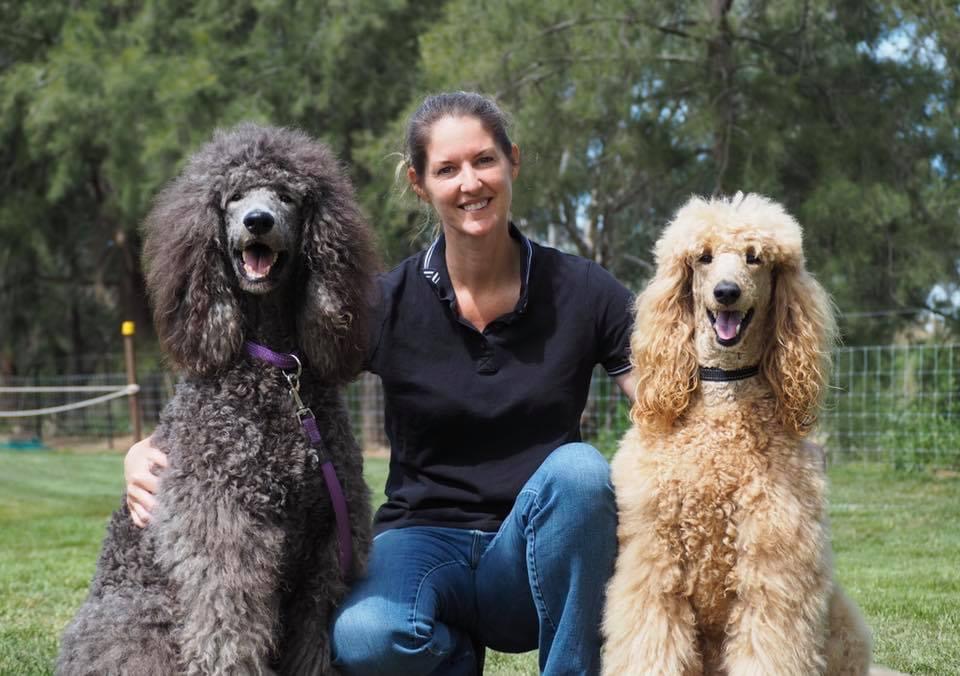 Instructor: Sharon Carroll
Sharon (she/her) has been a professional animal trainer for 30 years. She has been both a presenter and trainer in a range of animal shows, and currently operates, a dog training and behaviour consulting business based in Newcastle, Australia. (Click here for full bio and to view Sharon's upcoming courses.)


Copyright © Fenzi Dog Sports Academy and individual instructors.
Connect with us! 

