There really IS a roadmap to success in this sport. This class lays it out, from the foundations every search dog needs, through the advanced skills for NW2/NW3, to what it takes at Elite and Summit. Then it teaches you how to use that roadmap to train your dog and trial with a plan. The goal is simple: don’t struggle through the levels, and don’t get stuck short of your team’s potential.
We start with Foundations. Advanced teams, take note! “Go back to Foundations” is advice everyone gives and almost nobody defines. We’ll put real meaning behind the word for both the dog and the handler, so that if something is missing, you’ll know exactly WHICH foundation it is and how to fix it.
Next, we craft the search dog you actually have. Is your dog more eyes or more nose? What assumptions has your training built in without you realizing it? You’ll learn to set searches that test one skill at a time, use hide placement to build smart search habits, and plan blank and unproductive areas into your training.
Then we work on the balance between dog and handler. Independence comes first, but as you move up, your influence matters more and more. We’ll look at how that balance shifts from NW1 to Summit, how to be Suggestive rather than Directive, and how to keep from overworking an area. You want to be a true teammate, neither taking over the search nor giving up your role in it.
Finally, we turn to competition. No two searches are the same, so you need to read a search area, use the walkthrough, build a search plan, and decide when a search pattern helps and when it hurts. Then you need to adapt when the search doesn’t go the way you planned!
This class is best suited for:
NW2/NW3 handlers (and equivalent in other organizations). These concepts can make or break how smoothly you move through these levels, and they set you up for the upper levels.
Elite/Summit handlers. Your searches are the most variable, and a dog new to Elite is still pretty “green.” Are you building toward Summit with a plan?
Teaching Approach
Each week includes several written lectures with lots of trial and training video from my own dogs, with Elite and Summit searches included. Most lectures include a self-test or reflection questions so you can find where YOUR team needs to focus, and homework is often chosen to fit your team’s needs. Your journey is different from your classmates’, so work on what matters for your team rather than trying to check off every box.
NOTE: This class will offer a Teaching Assistant (TA) who will be available to Silver and Bronze students in the Study Group. FDSA TAs will answer questions and review videos in the Student Study Group.
Stacy Barnett is both a sport and working dog handler. She is a top nosework competitor and trainer, and the first handler to put multiple Summit titles (16 so far) on 3 dogs (Judd SMTx3, Brava SMTx7, Powder SMTx6) in the National Association of Canine Scent Work (NACSW)... (Click here for full bio and to view Stacy's upcoming courses)
Weeks 1 & 2: Foundations We start by defining the roadmap: Foundations, Advanced Skills, and Beyond! Then we take a deep look at the foundations for both halves of the team.
Week 1, the dog’s foundations:
The Roadmap to Success: Foundations, Advanced Skills, and the skills you need for Elite and Summit
Confidence and acclimation: environmental confidence vs. skill confidence
Focus and optimal arousal: environment, handler and search focus, plus the downshift between hides
Developing strong independent searching
For the advanced team: working in the absence of odor
Week 2, the handler’s foundations:
Reading the dog in and out of odor: the behavior chain from Change of Behavior to alert, and what a dog looks like with no odor
Handling basics: how your motion, shoulders, position, hands, voice and eyes cue your dog
Line handling, including Flexi lines, barriers and untangling
Timing of your marker word
Establishing trust with your dog
Weeks 3 & 4: Diagnosing Areas of Focus You get what you practice! We’ll assess your dog’s natural tendencies and learn to use hide placement and search design to build on strengths and shore up challenges.
Understanding the search dog: eyes vs. nose
Testing for eyes vs. nose and context problems, including blank vehicles and blank containers
One skill at a time searching
Challenging your dog’s assumptions
Developing dog-driven patterns through hide placement
Building unproductive and blank areas into your training plans
Week 5: Developing the Balance Between Independence and Handler Direction
How the balance changes as you move from NW1 up to Summit
Learning how to give and take control: being Suggestive rather than Directive, and using directed searching without overpowering your dog
How to avoid overworking an area that’s already cleared or blank
Week 6: Search Patterns and Search Plans This week is all about ADAPTATION.
Reading a search area and using the walkthrough effectively
What a search pattern is and how it differs from a search plan
Changing your approach for known vs. unknown number of hides
There are no titling requirements. Teams preparing for or trialing at NW2/NW3 or Elite/Summit (or the equivalent in other organizations) are best suited for Gold spots.
Helpful to have:
Optional: A friend to set blind searches for you. Several assignments work best blind, and one asks your helper to time the search.
Access to large search areas for the unproductive and blank area work... size depends on the team's experience level
Your search line and harness. You’ll be working on line handling in Week 2.
Containers and/or vehicles for the eyes vs. nose and blank-search exercises
Optional: your own trial videos and NACSW walkthrough videos to analyze in Weeks 5 and 6
Nosework is a TEAM sport. We initially teach the dog to search independently so that they become less reliant on us. After all, we can’t smell the hide! This is extremely important because dogs will defer to us. In fact, studies have shown that dogs will prioritize social cues over olfactory cues. This means that if you get involved, your dog will pay more attention to you than to the odor! This can easily mean a missed hide, or even worse, a false alert.
What are Social Cues?
Social Cues include the non-verbal communication that you are constantly giving your dog at every waking moment. In fact, there is something even with how dogs self-domesticated that have innately cued them into our signals. Dogs are the only species to truly understand pointing. Even our closest relatives, Chimpanzees and Bonobos don’t innately understand pointing. There’s a fabulous book called, “The Genius of Dogs” by Brian Hare that discusses this in length. Dr. Hare is an Anthropologist who has studied dog evolution in depth as a way to understand our own evolution. The latest thoughts about domestication are that dogs actually self-domesticated , and in a matter of a few generations the Proto Dog was developed from wolves who were less fearful of humans. It seems that the ability to understand our gestures piggybacked in a way during the domestication process. It’s really fascinating stuff!
So the upshot is that dogs understand our handling cues when we do detection work (or really any sport) even when we don’t purposely try to communicate with them. As an example, if you are an agility competitor, this will be familiar to you. Have you ever run your dog on a long line of jumps only to accidentally turn your shoulders? What happens to the dog? It pulls the dog off the line and you and up with an off course. This happens at TOP SPEED. Now when we are doing detection, the dog has a similar task focus (meaning the dog is focused on searching, where the agility dog may be focused on the next obstacle) only the dog is moving at a much slower speed than on the agility course. They are STILL LISTENING TO YOUR BODY LANGUAGE! Your shoulders are still important and can have a similar large impact to the dogs motion.
This is why when we handle, we want to be as neutral as possible UNLESS we want to purposely apply a cue. When handlers are unaware of their body language, the result is what I call a “Finely Tuned False Alert”. Oftentimes I hear handlers say that their “dog lied”. This is a huge pet peeve of mine. Most of the time, false alerts are caused by the handler and a cue that the handler mistakenly applied (other reasons for false alerts include confusion or the dog wanting to halt the search for some reason, purposely throwing a behavior that stops the search…. Neither of which are “lies”, especially when the handler learns to read canine body language).
How can we become neutral?
Well the answer to that is basic. We can learn what our bodies are communicating. This concept is rather common in the agility world. Linda Mecklenburg developed a handling system based on these concepts. Interestingly, I don’t think anyone has told her that her handling book is also a Nosework book! She has a super synopsis of handling cues and their affect/purpose. Each of these cues can be adopted and evaluated from a Nosework perspective.
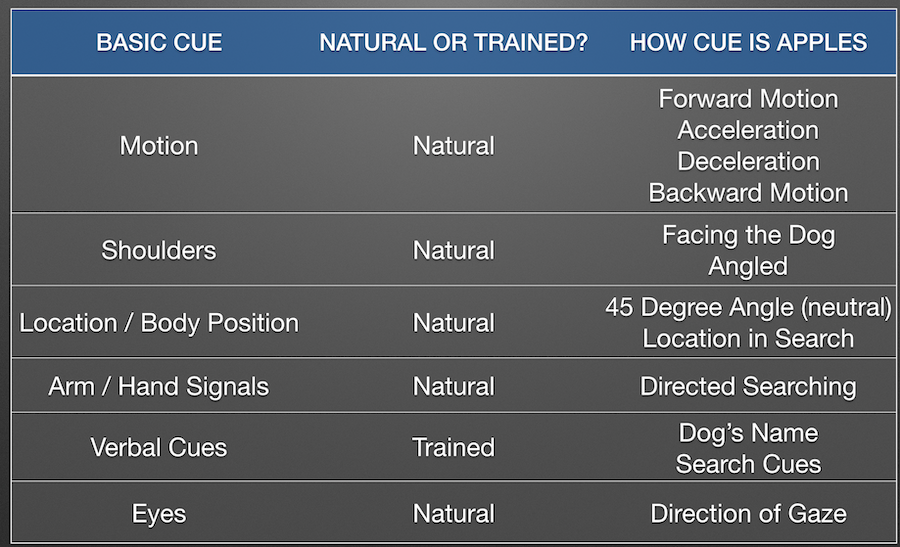
I’ve developed a table similar to Linda’s although focused on Nosework. There is one minor difference. Where arm and hand signals are considered to be “Trained” in agility, I consider these cues to be natural because dogs naturally understand pointing gestures.

All of these cues have meaning! I’ve developed my own “handling system” for Nosework based on these motion based cues. This lecture is meant to give you an overview so that you can start to become aware of how you affect the dog. Let’s review each of these cues.
MOTION
Motion itself when moving at the same pace as the dog communicates nothing. If you run behind your dog at the same speed, with neither acceleration or deceleration, you are communicating neutrality. This is why when we handle, we want to avoid changing our pace in relation to our dog.
Acceleration however has a large impact. We are telling our dogs to “move on”. If we are doing a Container search for instance, this can result in the dog passing up a “hot” container and missing the hide.
Deceleration on the other hand tells our dogs to “slow down” and pay attention. When we slow down, so does the dog! What this can result in is a handler mistakenly thinking a dog has caught scent. So the handler becomes more interested in the area…. Which causes the dog to be more interested in the area…. Which causes the handler to be more interested in the area…. And so forth until you get a “Finely Tuned False Alert”.
Backward Motion on the other hand is when a handler faces the dog and backs up. This has a focusing effect on the dog. You will see many handlers of Professional K9’s handling in this manner. Often Nosework handlers emulate this maneuver and it’s easy to mistake the dog’s focus for In Odor Behavior.
SHOULDERS
Shoulders are VERY obvious to the dog! With Nosework handling, you can either stand with shoulders squared off to the dog or you can open shoulders and stand at an angle to the dog. Both of these positions communicate something different.
Standing with your shoulders squared tells your dog to stay put. Assuming that the hide is not in the spot opposite the handler, this can cause the dog to overwork the area. Overworking an area in a blind situation can end up with a false alert because the dog will finally try to appease the handler assuming that an alert is what the handler wants. Keep in mind, that the odor may be present in the area, but it could be pooling away from source. Presence of odor doesn’t always mean presence of source!
Standing with your shoulders angled gives the dog permission to leave the area. In the case of working an area for scent, the dog is able to say “not here” and move on. This is an essential body position for the Nosework handler.
LOCATION / BODY POSITION
Your location and body position are additional essential clues to the Nosework dog. Your dog will search in your proximity and your body position relative to the dog will indicate how neutral you are to the search area.
Dogs have what I call a “Proximity of Influence”. This essentially means that the closer you are to the dog, the more influence you exert on the dog. I wrote a blog on this a while back: https://scentsabilitiesnw.com/blog/proximity-of-influence/
Therefore, as a handler gets closer to the dog, the handler communicates with the dog. It takes a very independent dog to search at a distance from the handler.
The handler’s position relative to the search area is important as well. I’ve found that the ideal position of neutrality is a 45 degree angle. If you are behind your dog and away from a surface by a 45 degree angle, you are exerted as little influence on your dog as possible. This is especially important when working Containers and Vehicles.
ARM AND HAND SIGNALS
We’ve already established that dogs listen to our pointing cues. Essentially, if you point at it, your dog will search it. As handlers, we try to avoid pointing at the hide directly. If you have a need to ask your dog to search something more closely, it’s much better to use a sweeping gesture. If you point at something directly, your dog may misinterpret your cue to mean that you want him to alert on the item. Directed Searching is therefore a large source of unintentional false alerts!
VERBAL CUES
Verbal cues are entirely trained. With verbal cues we asked the dog to search and we communicate with the dog to find another hide (we will start to teach the dog this cue this week). Verbal cues can also include using the dog’s name or getting the dog’s attention so that you can encourage the dog to search a part of the search area. Of course keep in mind that our dogs don’t understand that we have search boundaries! Search boundaries are manmade and not obvious to the dog.
Verbal cues need to be used judiciously. Excess chatter of course can result in the dog ignoring the handler. However, if we ask a dog to do something, we are also increasing our likelihood of a false alert! Our dogs are smart. They understand that we want an alert. Simply re-cueing the dog in the presence of no odor can in fact cause the dog to False Alert. This is something else that researchers have proven. Yes! Dogs WILL false alert in the presence of no odor if they believe that the handler would like them to alert.
EYES
The location of your gaze also communicates to the dog. Your eyes will draw them to search where you are looking. Your eyes can also lock onto theirs and your previously independent dog may start staring at you instead of searching! Remember that Handler Focus is contra to Search Focus.
I’d like to share a video with you of a search that I did with my dog Judd during competition. This is an Elite level search. We were not told how many hides there were. I love sharing this search because each of these cues can be seen on my handling. We were successful in finding all of the hides in this search!
A sampling of what prior students have said about this course...
This course provided a wealth of applicable information for the professional scent detection dog team (not just the Nosework sports teams). I would recommend this class to anyone who wants to improve and learn about their search techniques.
Stacy, this was an excellent class which helped me with my high arousal Lab. I hope with the handling techniques I learned, we can improve our Scentwork.
Stacy is one of my favorite Fenzi instructors. She takes a lot of time with every student and cares a lot about the learning process.
Stacy, you could put all these lectures into an excellent book on nose/scent work!!! Loved this class.
Registration
Next session starts: December 1, 2026Registration starts: November 22, 2026Registration ends: December 15, 2026

 Instructor: Stacy Barnett