logo

  • Log In
  • Lectures
  • Homework Forum
  • Discussion Forum
  • About Us
  • Calendar
  • Faculty & Staff
  • instagram-icon
  • facebook-icon
  • twitter-icon
  • Courses
    • Schedule
    • By Discipline
    • By Instructor
    • Prerequisites
    • Self-Study
    • Scholarships
    • Gift Certificates
  • Webinars
    • Schedule
    • FAQ
  • Workshops
    • Schedule
    • FAQ
    • Gift Certificates
  • On Demand
    • Pet Dog Presentations
    • Pet Professionals Presentations
    • Self-Study Courses
  • Special Links
    • Podcast
    • Blog
    • Fenzi TEAM Titles
    • Trainer Certificates
    • Private Lessons
    • Other Free Stuff!
    • Swag
  • Conferences
    • CANIS Conference Registration - Attend In-Person
    • CANIS Conference Registration - Virtual Attendance
  • Contact
    • Course FAQ
    • Webinar FAQ
    • Workshop FAQ
    • Testimonials
    • Contact Help
  • Courses
    • Schedule
    • By Discipline
    • By Instructor
    • Prerequisites
    • Self-Study
    • Scholarships
    • Gift Certificates
  • Webinars
    • Schedule
    • FAQ
  • Workshops
    • Schedule
    • FAQ
    • Gift Certificates
  • On Demand
    • Pet Dog Presentations
    • Pet Professionals Presentations
    • Self-Study Courses
  • Special Links
    • Podcast
    • Blog
    • Fenzi TEAM Titles
    • Trainer Certificates
    • Private Lessons
    • Other Free Stuff!
    • Swag
  • Conferences
    • CANIS Conference Registration - Attend In-Person
    • CANIS Conference Registration - Virtual Attendance
  • Contact
    • Course FAQ
    • Webinar FAQ
    • Workshop FAQ
    • Testimonials
    • Contact Help

Prerequisite Classes

CC350: Canine Fitness Circuit Training

Course Details

This six-week Canine Fitness Circuit Training class is created to introduce dogs and handlers to a variety of fitness concepts through a structured circuit-training format. This class will have a TA.

Each week will feature 3 - 5 fitness stations focusing on specific components of canine fitness. At the beginning of class, I will introduce the week's fitness focus and provide a short explanation and demonstration of each station. I will discuss the purpose of the exercises, proper positioning, equipment use, safety, and what handlers should look for while their dogs are working. You DO NOT need a lot of space everything shown in the demos is set up only using a small amount of space. 

After instruction, dog-and-handler teams will begin the circuit, rotating through each station and practicing the exercises at an appropriate level for their dog. The emphasis will be on quality of movement, proper form, control, and confidence rather than speed.

As the course progresses, the circuits will build upon previously introduced concepts while providing new challenges in strength, balance, coordination, stability, and overall body awareness.

Weekly Class Format (see syllabus for further detail)

Each class will include:

  • Introduction to the week's fitness focus
  • Short lecture and demonstration of each circuit station
  • Explanation of proper form, safety, and the purpose of each exercise
  • 3–4 fitness stations
  • Handler-and-dog teams rotating through the circuit
  • Instructor coaching and individual modifications as needed for working spots
  • Rest and recovery periods incorporated into the circuit
  • Progressions and alternative options

By the end of the six-week course, handlers should have a better understanding of how canine circuit training can be used to work on different components of fitness. Handlers will learn how to safely guide their dogs through a circuit, use fitness equipment appropriately, recognize good movement and positioning, and understand when an exercise should be progressed or modified.

Throughout the course, the priority will be safe, controlled, quality movement. Each dog will be encouraged to work at an appropriate level based on their individual ability, confidence, and fitness level.

Teaching Approach:

 This class

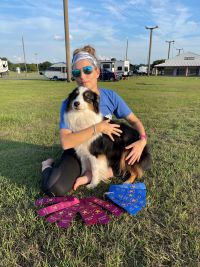
Ashley EscobarInstructor: Ashley Escobar

 Ashley Escobar (she/her) has been training dogs and their people for over 20 years. She is a retired college professor of mathematics with a masters of mathematics and also holds a master’s degree in veterinary science, with advanced veterinary coursework and a background in clinical canine rehabilitation also studying animal biomechanincs. ..(Click here for full bio and to view Ashley's upcoming courses)
Syllabus

View Full Syllabus

Week 1 Introduction to Circuit Training & Body Awareness

Our first week introduces dogs and handlers to the circuit-training format and the fitness equipment used throughout the course. The primary focus will be body awareness, proper positioning, and controlled movement.

Handlers will learn how to move through the stations, how to introduce equipment appropriately, and why correct form is more important than speed or the number of repetitions completed. This week creates the foundation for the more challenging circuits to come.

Week 2 Coordination & Controlled Movement

This week's circuit focuses on coordination and purposeful movement. Dogs will work through stations that encourage them to think about where and how they place their bodies while moving through different exercises.

The short lecture will discuss movement quality, pace, alignment, and why slowing an exercise down can make it more physically and mentally challenging. Handlers will continue learning to recognize when their dog is moving with control versus simply rushing to complete an exercise.

Week 3 Core Engagement & Stability

Week three focuses on core engagement and stability. The circuit will challenge dogs to maintain appropriate body position while working through different fitness stations.

Handlers will learn about the importance of the dog's core in supporting balance, posture, and controlled movement. We will also discuss how equipment and body position can change the difficulty of an exercise and why progression should be based on the individual dog's ability.

Week 4 Strength & Body Control

This week's circuit introduces a greater strength and body-control component. Dogs will use skills developed during the first three weeks while working through stations designed to encourage controlled use of different areas of the body.

The lecture portion will focus on proper form during strengthening activities, recognizing compensation, and understanding why a more difficult exercise is not necessarily a better exercise. Handlers will learn when to progress an activity and when to modify it.

Week 5 Balance, Coordination & Dynamic Movement

Week five brings several fitness components together. The circuit will focus on maintaining balance, coordination, and control while the dog is moving and transitioning between activities.

Handlers will learn how movement, direction changes, equipment, and transitions can increase the challenge of a fitness circuit. The emphasis will remain on maintaining good form and confidence as the exercises become more dynamic.

Week 6 Full-Body Fitness Circuit

Our final week brings together the concepts and skills developed throughout the course. Dogs and handlers will work through a full-body fitness circuit incorporating elements of strength, balance, coordination, stability, body awareness, and controlled movement.

The lecture will review the principles of creating a balanced canine fitness circuit, including exercise selection, appropriate difficulty, rest periods, progression, and recognizing fatigue.

This final circuit gives handlers an opportunity to apply what they have learned while seeing how individual fitness exercises can be combined into a structured workout.

Prerequisites and Equipment

Equipment 

Equipment List:  I am creative so if you don't have something on the list I can likely help you make something

Platforms & Targets

  • 2–4 low, non-slip fitness platforms in various sizes
  • 1–2 raised platforms/step platforms
  • 1 pivot platform
  • 2–4 flat paw/foot targets
  • Rubber or yoga mats for traction and station boundaries

Balance & Stability Equipment

  • 2–4 balance pads
  • 1–2 balance discs
  • 1 wobble board
  • 1–2 canine balance pods or similar paw targets
  • Inflatable balance equipment, such as a peanut, FitPAWS TRAX, or similar equipment (optional for more advanced work) A roll of foam.

Cavaletti & Movement Equipment

  • 6–10 cavaletti poles
  • Adjustable cavaletti cones/holders
  • 6–8 cones
  • Ground poles/PVC poles
  • Low hurdles
  • Floor markers or spot markers

Strength & Body-Awareness Equipment

  • Low step/step bench
  • Stable blocks of different heights
  • Paw targets
  • Incline/ramp or wedge (means to make something incline) 
  • Two matching platforms for split-position work

General Class Supplies

  • Non-slip mats for all working areas
  • Timer for station rotations
  • Measuring tape for adjusting cavaletti spacing

Sample Lecture

More

Welcome to circuit work! I am so excited you have chosen to spend the next six weeks with me. This is my personal preferred fitness style when it comes to working my own dogs. I prefer this style of work for lots of reasons: 1. it is a lot of fun to keep things moving and I don't love drills 2. it allows me to be flexible with my day, as I can set up several "stations" and work multiple dogs with something that I have set up. 3. I am growing precision movements and proprioception in my dogs at a greater rate with having such intentional set-ups laid out. 4. this is a functional approach to fitness that most of my clients find easy to remain accountable. 

So here we are, this first week is all about introducing circuits. One important thing to remember is that our goal is not speed, high repetitions or exhausting the dog on any level. Our goal this week is to teach our dogs how to use their bodies with thoughtfullenss and intentional motions. We will also be working on our handler mechanics. Where we stand, how and where we deliver reinforcement and what methods we use to approach each exercise etc. We are looking for proper form while tareting specific muscle groups and working towards specific motions and weight shifting. 

Body awareness aslo referred to in this class interchangeably as proprioception, is our dogs ability to know where their limbs are in a given space. This "awareness" helps our dogs in everyday life and particularly in their sports career. Dogs in general have good front end proprioception. The front end carries 60% of the dogs total weight and leads the body, therefore they are innately more aware of where their front end is. Their hind end, is a different story! 

One purpose of the exercises chosen for this class is to help our dogs develop a stronger body awareness and control of all feet, particularly the rear. We will want our dogs to be intentional with movments. We as the trainers have to be intentional with our reinforcement strategies. This means we are purposeful with when, how and where we mark and deliver reinforcement. Our dogs need to know how to earn reinforcement, this will help prevent frustation and build a confident dog. Goals! 
With that being said, we need to be sure to not reward thereby rehearse scrambling or frantic movements. 
A dog who knows how to slow down and think about where their body is in space, with the precision of each individual paw movement is going to be able to access the muscular structure we are aiming for and cause each exercise to be used for the intended purposes. This means we want quality over quantity. If my dog performs two quality repetitions I am much happier than if the dog did four with frantic sloppy movements. 

Each exercise in this class will be called a "station" and is assigned some sort of equipment or prop

Testimonials & Reviews

Read All Testimonials

New class!

Registration

Next session starts: October 1, 2026
Registration starts: September 22, 2026
Registration ends: October 15, 2026

Registration opens at 10:30am Pacific Time. 

CC350 Subscriptions


Gold

Silver

Bronze
Tuition $ 260.00 $ 130.00 $ 65.00
Enrollment Limits 12 25 Unlimited
Access all course lectures and materials ✔ ✔ ✔
Access to discussion and homework forums ✔ ✔ ✔
Read all posted questions and answers ✔ ✔ ✔
Watch all posted videos ✔ ✔ ✔
Post general questions to Discussion forum ✔ ✔ ✖
Submit written assignments ✔ ✖ ✖
Post dog specific questions ✔ With video only ✖
Post videos ✔ 1 per week ✖
Receive instructor feedback on
  • Questions
  • All videos
  • Questions
  • All videos
✖

Find more details, refund policies and answers to common questions in the Help center.

  • Prev
  • Next
  • FDSA
    • About Us
    • What Do We Teach?
    • Faculty & Staff
    • Testimonials
    • Privacy Policy
  • Student Resources
    • Calendar
    • Scholarships
    • Gift Certificates
    • Swag
    • Trainer Certificates
  • Courses
    • Class Schedules
    • By Instructor
    • By Discipline
    • Prerequisites
    • Self Study
  • Webinars
    • Schedule
    • Webinar Courses
    • Register
  • More Learning
    • Podcast
    • Blog
    • Puppy Book
    • Private Lessons
    • Team
  • Help!
    • Getting Started
    • Enrolled Students
    • Video & Images
    • Webinars

Copyright © Fenzi Dog Sports Academy and individual instructors.

Technical support - send email to [email protected]

Connect with us! facebook-icon email-icon instagram-icon