logo

  • Log In
  • Lectures
  • Homework Forum
  • Discussion Forum
  • About Us
  • Calendar
  • Faculty & Staff
  • instagram-icon
  • facebook-icon
  • twitter-icon
  • Courses
    • Schedule
    • By Discipline
    • By Instructor
    • Prerequisites
    • Self-Study
    • Scholarships
    • Gift Certificates
  • Webinars
    • Schedule
    • FAQ
  • Workshops
    • Schedule
    • FAQ
    • Gift Certificates
  • On Demand
    • Pet Dog Presentations
    • Pet Professionals Presentations
    • Self-Study Courses
  • Special Links
    • Podcast
    • Blog
    • Fenzi TEAM Titles
    • Trainer Certificates
    • Private Lessons
    • Other Free Stuff!
    • Swag
  • Conferences
    • Skills & Beyond: Obedience & Rally from the Backyard to Competition! - May 16, 2026
    • CANIS Conference Registration - Attend In-Person
    • CANIS Conference Registration - Virtual Attendance
  • Contact
    • Course FAQ
    • Webinar FAQ
    • Workshop FAQ
    • Testimonials
    • Contact Help
  • Courses
    • Schedule
    • By Discipline
    • By Instructor
    • Prerequisites
    • Self-Study
    • Scholarships
    • Gift Certificates
  • Webinars
    • Schedule
    • FAQ
  • Workshops
    • Schedule
    • FAQ
    • Gift Certificates
  • On Demand
    • Pet Dog Presentations
    • Pet Professionals Presentations
    • Self-Study Courses
  • Special Links
    • Podcast
    • Blog
    • Fenzi TEAM Titles
    • Trainer Certificates
    • Private Lessons
    • Other Free Stuff!
    • Swag
  • Conferences
    • Skills & Beyond: Obedience & Rally from the Backyard to Competition! - May 16, 2026
    • CANIS Conference Registration - Attend In-Person
    • CANIS Conference Registration - Virtual Attendance
  • Contact
    • Course FAQ
    • Webinar FAQ
    • Workshop FAQ
    • Testimonials
    • Contact Help

AG475: Big Feelings: Building the Ideal Brain State for Agility

Course Details

Does your dog get big feelings around or during agility? You’ve come to the right place!

Do they get amped up, over-aroused, or too high in the face of obstacles, midst of sequencing, or even the environment itself? Or do they start to stress down or shut down instead? Do they have big feelings about watching agility or social pressure in their agility environment? Do they struggle with repetition or errors occurring in training or trialing? Do they do fine in training or at home and then struggle the second you bring their skills to a new or trial environment? In this six week class, we will be covering all of this and more.

Agility itself can be a very mentally complex sport for any dog— and that’s without adding any additional factors! Once we add in those factors, feelings can start to build very quickly. 

Factors such as:

  • Big excitement or intensity for agility
  • Confusion and miscommunication
  • Errors on course or in training (and low tolerance for it)
  • Repetition in training
  • Environmental factors like other excitable dogs/staring dogs or just dog/people social pressure
  • Great importance for getting access to agility 
  • Stimulation due to motion
  • Low tolerance for not feeling 100% correct
  • High arousal related to the sight of the equipment
  • Conflicted feelings or importance attached to reinforcers or lack there of

can easily cause dogs to display big feelings-induced behaviors like barking, spinning, freezing, slowing down, taking obstacles without listening, looking for someone to greet, jumping up or bouncing off of handler, running away, offering random obstacles or behaviors, stealing reinforcement, and many more.

This, as a result, does not put dogs in the best brain state to be training or trialing in agility. And when dogs do get to that big feelings brain state, it can become really hard for them to regulate and bring themselves back down.

So that’s exactly what we are going to be learning all about! You will not only help your dog learn how to regulate once those big feelings start, but also how to keep those big feelings from popping up to begin with through: 

  • A new, clear framework for your dog to follow throughout training and trailing
  • Reset station structure for when feelings build or something goes wrong
  • Opt out station work
  • Big feelings regulation games
  • Warm up games for the optimal brain state
  • Environmental regulation exercises

Throughout these six weeks, these will build the clarity and predictability that your dog needs to achieve the optimal brain state for agility!

Note: this class will also be applicable to anyone whose dog does not currently have big feelings connected to agility, and is hoping to avoid building them into the agility picture!

Teaching Approach:

Lectures will be released at the top of each week. They will be a combination of written instruction and video demos.

Feedback will consist of written feedback and screenshots with specific timestamps as applicable.
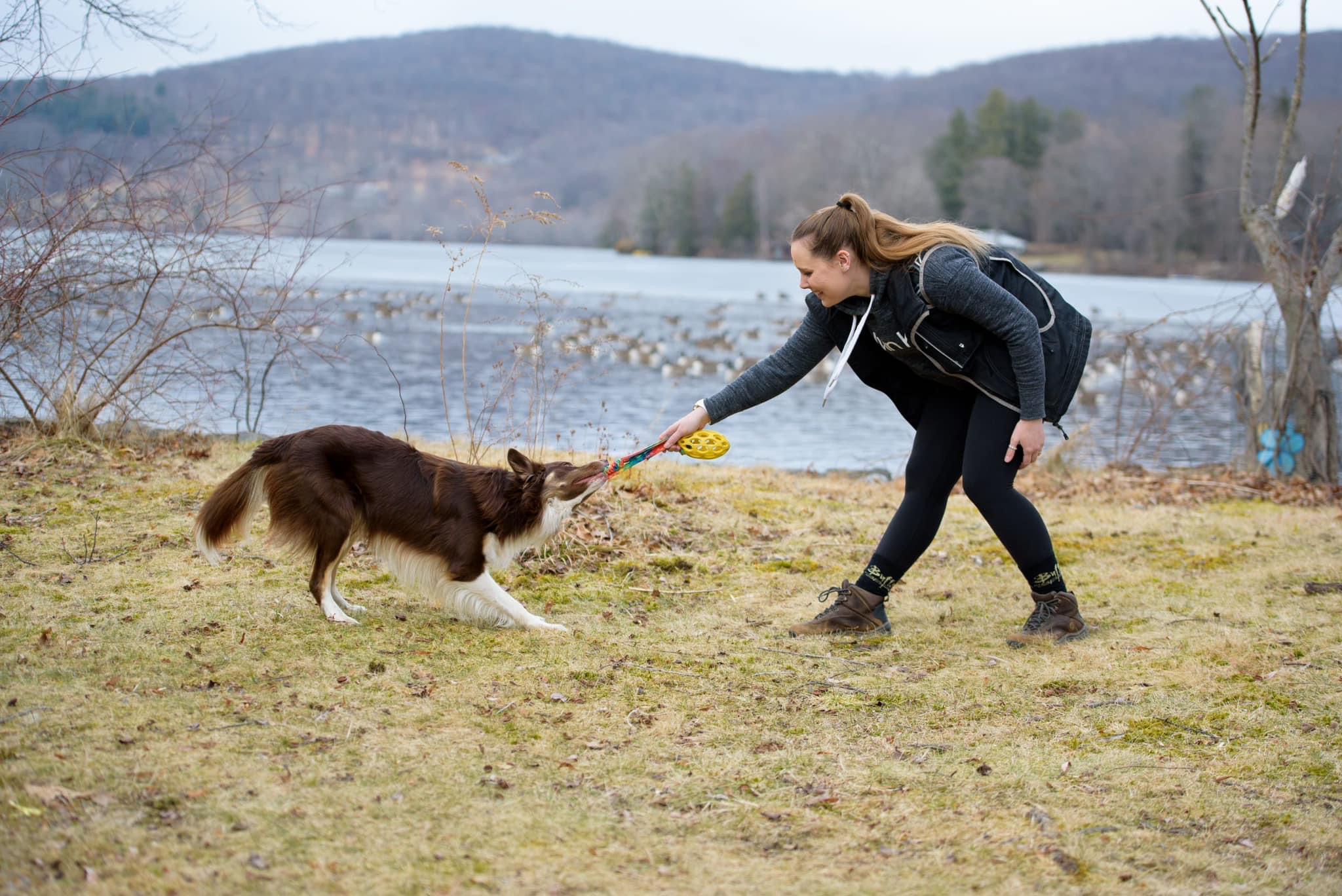
Bronagh DalyInstructor: Bronagh Daly

Bronagh Daly is a Certified Control Unleashed Instructor, Certified Family Dog Mediator, Certified One Mind Dogs Instructor, and a graduate of the Aggression in Dogs Master Course. She does not believe in one-size-fits all...(Click here for full bio and to view her upcoming classes)

Syllabus

View Full Syllabus

WEEK ONE

  • What do we mean by big feelings? How do they impact agility?
  • Common triggers
  • Reset stations – ways to win
  • Loops for clarity
  • Regulation games – foundation
  • Warm up/transition patterns
  • Opt out structure


WEEK TWO

  • Training structure
  • Normalizing waiting
  • Minimizing frustration
  • Transitions – going from one task to the next
  • Single skill loops – known skill
  • Single skill loops – new skill
  • Regulation games – adding excitement & start lines


WEEK THREE

  • Training structure – put to the test
  • Either/or for success
  • Broken expectations
  • Transitions – teaching patience
  • Multi skill loops
  • New skills
  • Regulation games – adding agility


WEEK FOUR

  • Pressure/release:
    • Environmental stressors
    • Sound stressors
    • Social pressure
  • Trialing/seminar structure
  • Regulation games – new environments
  • Split focus
  • Start line games


WEEK FIVE

  • Apply structure to trialing
  • Skill loops for new skills
  • Behavior chain skill loops (sequences)
  • Repetition – maximize your sessions
  • Arousal testing
  • Rehearsing when things go wrong


WEEK SIX

  • Reset stations and skill loops – full training session (something new)
  • Reset stations with pressure/release
  • Start line testing
  • Skill loops with environmental/social pressure
  • Making your own loop
  • Entering new environments


Note: because this is a new class, the syllabus is subject to change!

Prerequisites and Equipment

Appropriate for dogs of any age who have at least a basic understanding of agility training!

Needed:

  • Exercise dots. I like to use these: https://www.amazon.com/dp/B0BSCWDS38?ref=ppx_yo2ov_dt_b_fed_asin_title&th=1
  • If you already use dots for a specific purpose, you can use a different shape like a star: https://www.amazon.com/Unixing-Markers-Classroom-Preschool-Kindergarten/dp/B07W39XVPY/ref=sr_1_1?crid=1Y9ELZ5H6UPD0&dib=ehttps://www.amazon.com/Unixing-Markers-Classroom-Preschool-Kindergarten/dp/B07W39XVPY/ref=sr_1_1?th=1 
  • A mat, station, or snuffle mat that your dog is comfortable with
  • Most exercises won’t need more than 1 to 3 jumps (many include just 1 or wings) or a tunnel, but for at least one or two exercises later in the class, you will require access to a full sequence.

Sample Lecture

More

Let’s talk reset stations! They are one of my favorite things to use with dogs who have a lot of feelings about agility training or any aspect of agility, including the environment.


What are they exactly? Essentially a place that you can cue your dog to go (or they can eventually choose to go) when feelings start to build, an error occurs, or something causes one or both of you need a moment to think/regulate. At the same time, they act as a way to get your dog to reinforcement outside of what you are currently working on. I also love to use reset stations for dogs to struggle with repetition as a way to normalize it or break up training for them. And most importantly, they serve as a way for your dog to stay in a good brain state and engaged with your training session no matter what is going on.


We will be using reset stations in a few different manners throughout class and build several different skills upon them. But note that these are not the same as opt out/end of session stations, which we will be working on separately. When using a reset station, work is always going to occur afterwards in some form. Work or the training structure should ideally never end with your reset station.


For reset stations, we will be using an exercise dot. My preference for this type is to use round, flat, grippy exercise dots. We want our dogs to be able to see them easily and we also want our dogs to be able to move over our dots as needed without tripping etc. They should look something like these: https://www.amazon.com/dp/B0BSCWDS38?ref=ppx_yo2ov_dt_b_fed_asin_title&th=1

We will be using dots for other patterning purposes in class so if you would prefer that your dog understands the difference between a reset dot and just a dot used in other circumstances visually, it can be helpful to use a different object shape like a star: https://www.amazon.com/Unixing-Markers-Classroom-Preschool-Kindergarten/dp/B07W39XVPY/ref=sr_1_1?crid=1Y9ELZ5H6UPD0&dib=ehttps://www.amazon.com/Unixing-Markers-Classroom-Preschool-Kindergarten/dp/B07W39XVPY/ref=sr_1_1?th=1 

You can also just put one of your dots into another shape!

We want your dog to be able to easily identify their reset station as much as possible, so having an object only used for that purpose can be helpful for some dogs. For some dogs, it won’t matter as long as the structure of where the reset station dot is placed is clear and they know at any given time which dot is meant for resetting purposes and which dots are being used for other things. But if you have a dog with a lot of feelings who really thrives on clarity, I would stick with a shape used only for reset station purposes.


No matter which you choose, we will be starting everything the same way!

  • Begin by standing directly in front of one dot with your dog.
  • Say your dot cue, then place a piece of food on the dot.
  • Let your dog eat the food off of the dot.
  • After they finish eating, wait until your dog looks up at you.
  • When they do, repeat.
  • When that’s easy, try the same thing with two dots.
  • Repeat the same process each time where you pause after they give you eye contact, say your dot cue, then move onto the next dot and place food on that dot.
  • As soon as the food is placed on the dot each time, the food should be readily available to eat every time and your dog should go to immediately eat it.
  • Now continue adding dots like this until you can get up to four dots.


Once your dog is very comfortable with their dots, we’re going to add our first easy reset station exercise:

PART ONE:

  • Stand next to your reset station dot with your dog.
  • Cue a very easy behavior for your dog, slight pause, cue your reset station, then immediately move to it and reward dog on the dot.
    • I like to do a cue transfer here for the reset station. We will be using your “dot” cue as a general dot cue throughout class, so we want your reset station to have its own unique cue.
    • To do this, say your reset station cue first, then your dot.
    • So this could be “reset, dot.”
    • Do this for the first couple of repetitions, then drop saying “dot” and your dog should be predicting going there on the “reset” cue at this point.
  • Now take one step away and repeat.
  • Continue to add distance, always adding in repetitions where you move back in closer to the reset station to make sure you are not just continuing to add difficulty to this.

A few reps example here:

PART TWO:

  • Now go back to standing directly next to your reset station dot.
  • Cue two easy behaviors, followed by cueing your reset station.
    • By this point, you should have completed your cue transfer and just being using your “reset” cue.
  • Add distance as we did above with the two behaviors.
  • Go back to standing directly next to the reset station again and cue three known behaviors.
  • Once again, work at increasing distance as we did above.

A few reps example here:

PART THREE:

  • Now we are going to work on training something new with our station.
  • Have your reset station set out about five feet away.
  • Take a leash or any kind of string that your dog can easily see and place that in a line on the ground between you and your dog.
  • Throw a treat behind your dog for them to get if needed to create space.
  • As soon as your dog makes any motion back towards your leash/string, mark and reward with a tossed treat behind them.
  • Our goal is going to eventually be to get your dog to stop with their front feet just over the leash/string.
  • After three repetitions, cue your reset station and run over to it, rewarding your dog there several times.
  • After your dog looks to you at the end of three rewards, cue a treat away back behind the leash/string.
  • Continue like this, marking and rewarding for approximations of your dog initially getting to the point of having both front feet over the leash/string and eventually pausing there.
  • Stop every three repetitions to go to your reset station, then begin again.
  • If your dog is showing any signs of feelings increasing at any time or if anything goes wrong, immediately cue your reset station even if you have not done three repetitions yet. Then go back to your session!

A few reps example here:

That’s it for reset stations! Just so you can see where we’re going, here’s an example of how we might use reset stations down the line:

Now moving on…

Testimonials & Reviews

Read All Testimonials

New class!

Registration

Next session starts: June 1, 2026
Registration starts: May 22, 2026
Registration ends: June 15, 2026

Registration opens at 9:30am Pacific Time.

SILVER LEVEL Update - Students will be permitted to submit ONE 90 second video each week.  For additional details on all enrollment levels please view our Getting Started section on our Help Page.

AG475 Subscriptions


Gold

Silver

Bronze
Tuition $ 260.00 $ 130.00 $ 65.00
Enrollment Limits 12 25 Unlimited
Access all course lectures and materials ✔ ✔ ✔
Access to discussion and homework forums ✔ ✔ ✔
Read all posted questions and answers ✔ ✔ ✔
Watch all posted videos ✔ ✔ ✔
Post general questions to Discussion forum ✔ ✔ ✖
Submit written assignments ✔ ✖ ✖
Post dog specific questions ✔ With video only ✖
Post videos ✔ 1 per week ✖
Receive instructor feedback on
  • Questions
  • All videos
  • Questions
  • All videos
✖

Find more details, refund policies and answers to common questions in the Help center.


  • Prev
  • Next
  • FDSA
    • About Us
    • What Do We Teach?
    • Faculty & Staff
    • Testimonials
    • Privacy Policy
  • Student Resources
    • Calendar
    • Scholarships
    • Gift Certificates
    • Swag
    • Trainer Certificates
  • Courses
    • Class Schedules
    • By Instructor
    • By Discipline
    • Prerequisites
    • Self Study
  • Webinars
    • Schedule
    • Webinar Courses
    • Register
  • More Learning
    • Podcast
    • Blog
    • Puppy Book
    • Private Lessons
    • Team
  • Help!
    • Getting Started
    • Enrolled Students
    • Video & Images
    • Webinars

Copyright © Fenzi Dog Sports Academy and individual instructors.

Technical support - send email to [email protected]

Connect with us! facebook-icon email-icon instagram-icon