Are you looking for a new way to approach agility training both inside and outside the ring? Or a new solution to your agility training projects or problems? Let me introduce you to a dot!
Dots are currently my absolute favorite thing to use in agility. I have found them to be such a flexible training tool that you can apply them to almost anything you want to tackle or learn within the agility space.
In this class, we will be doing just that! We will start by teaching your dog the basic foundation of what to do with a dot and then proof that basic understanding in different situations and environments. Then from there, the applications will be extremely flexible and endless! Due to the value that we will very quickly and easily build up for these dots, you and your dog will learn how you can apply your dots to your general agility training and agility–related behavior training goals.
Because there probably are quite literally 101 ways that you can apply dots to agility, for the sake of this class, we are going to be applying the dots in a few specific overarching ways:
Single jump skills including independent backsides (wrap/slice), threadles (wrap/slice), and tight turns.
Arousal layering and big feelings around agility
Anti-rushing and commitment work for jumps
Environmental acclimation
Forward focus and distance work
Stopped contact independence
Running contacts
Independence for weaving (for dogs already weaving!)
Start lines
Structure for when something goes wrong in training
This class will act as a “choose your own dot adventure” of sorts where you can make the scope of your dot-related focus as narrow or as broad as you’d like by choosing how many topics you want to focus on throughout class. (And that can obviously change as class goes on!)
Regardless, you will walk away with a powerful new training tool and new way to approach your agility training!
Training Approach:
Lectures will be a mix of written instruction and video demonstration. There will be at least two lectures per topic at the top of each week, following week one. Feedback will be a mixture of written and video/voiceover instruction as applicable. Supplemental lectures and feedback will be tailored directly to the students in the specific session as the class goes on, so additional lectures will be added as class goes on.
Bronagh Daly is a Certified Control Unleashed Instructor, Certified Family Dog Mediator, Certified One Mind Dogs Instructor, and a graduate of the Aggression in Dogs Master Course. She does not believe in one-size-fits all...(Click here for full bio and to view her upcoming classes)
For this class, you may want to use dots of different shapes and sizes. It’s not required, but for some dogs, it can help with context to have slightly different looking dots for different tasks. Some examples:
Dots are my absolute favorite thing when it comes to arousal management for agility! The grounding concept of dots and the predictability of them just works absolute wonders for every agility dog I’ve worked with. This goes for dogs whose energy goes up and who might get very amped up when around agility or aspects of it as well as those whose energy goes down and who might stress down around agility or aspects of it.
We are going to cover many different ways and games throughout class to help your dogs learn to regulate their big feelings when around agility. However, we need to build up that initial foundation first!
To do this, we are going to work three specific exercises. The first will be regulating feelings with a toy or food/personal play, the second will be working those under stimulus control, and the third will be regulating feelings while introducing a wing.
Okay…let’s get into it then!
Exercise one:
For this first exercise, you will only need a dot, a neutral environment, some food, and a toy if applicable to your dog:
Start off by cueing the dot. When your dog moves to the dot, feed them immediately on it. (If you are going to use a toy here, your toy should be readily available in your hand.)
Wait for offered eye contact. When you dog looks up to you, cue them to play with you. If you are using a toy, cue them to strike the toy. If you are doing person play, verbally cue that. And if you are playing with food, cue your dog to start chasing the food.
After a bit of play, pause and say your dot cue. If you need to say your toy drop/end of play cue first that is fine!
Wait for your dog to head to your dot, then feed them on the dot as soon as they do.
Pause and wait for offered eye contact, then repeat.
Start off by keeping the play fairly calm, then as the session goes on or in a second session, you can start to build up the arousal level by amping up the play and raising your energy level.
If your dog finds this difficult, work several up/down repetitions on the dot between each play session. So when your dog finishes eating off of the dot, wait for eye contact, then feed on the dot again just as we did in the initial dot intro. Work this at least 2-3 times, then once you get eye contact again, you can cue a return to play.
Bonus addition: to raise the difficulty level, you can add in an agility space. Notice I say space and not environment though! You want this to be a space that has the expectation of agility, but not agility actually going on. So for example: an empty agility training room or the space in which you often train agility at home.
Double bonus: to add an additional difficulty level, you can now bring this to an environment that involves dogs and people, but again, agility should not actually be happening directly in your environment just yet!
Video example:
(some play was edited out for time)
Exercise two:
This exercise begins as a simple line of dots that you will add a reinforcer to in order to work both on split focus and stimulus control around reinforcers. I find that both of these things very easily raise arousal levels and cause feelings in agility. SO before we add agility to the mix, we will be working on those feelings!
For this exercise, you will need four dots and two toys or bowls of food and a neutral environment.
Place either a toy or a dish with food loaded into it in between each of the dots. The toys or the food should be lower value to start.
Go up and down the line of dots as you normally would, getting eye contact before cueing each, acting as if the toys or dishes are not there. Your dog should be able to give you eye contact after being fed on each dot as normal and should be able to walk by the toys/dishes with you as if they are not there. Continue until your dog is able to do so.
If this is difficult for your dog, start with the toys/dishes slightly out of line so your dog doesn’t have to walk directly by them, then slowly move them back in line with the dots over reps/sessions.
Now as you’re going up the line of dots, wait for eye contact at a random dot and instead of cueing them to go to the next dot, verbally cue them to grab a toy or eat out of a bowl (and physically indicate which for clarity after the verbal cue).
If you’re using a toy, play with your dog for a bit, then ask them to drop the toy, place it back in line, and return to the dots. If you’re using a bowl, refill the now empty bowl, wait for eye contact, and then continue with the dots.
As an added layer, once you introduce the toy or the bowl, you can also add in a sustained nose or chin target before returning to the dots!
Adding difficulty: Again, we want this to start in a neutral, quiet environment. But once your dog is proficient with this exercise, we can start to add in the expectation of agility by doing it either in an environment that predicts agility (so not where agility is actively happening) or around agility equipment.
I really love this exercise because eventually it can also act as a lovely warm up for your dog before runs at a class or trial!
Video example of a lovely student:
Exercise three:
It’s finally time to add in a little bit of agility! Now that your dog is learning to regulate their feelings with a dot, it’s time to add in the beginnings of agility.
I like to start by adding in wing wraps because they have easy criteria for dogs to understand and succeed at, but they also tend to easily ramp up feelings:
Begin with a dot in between two wings.
Say your dot cue and once your dog heads to their dot, feed them on it.
Wait for eye contact, then throw a piece of food away for your dog to get (use LSM if you have it).
Once they get the food, cue them to return to their dot.
Repeat this several times and make sure your dog is quick to respond to your cues each time.
When they are, add in one wing wrap. As soon as your dog is done wrapping the wing, cue them to go back to the dot.
Feed on the dot several times between getting eye contact.
Add in another wing rep.
Continue this way, alternating the dot and a wing wrap.
Start off with just one wing, then you can start to cue the other wing as well as the session goes on.
Continue until you are able to wrap both wings separately without a drop in fluency of cues.
If your dog finds this difficult, spend more time at the beginning stages and spend most of your time feeding eye contact at the dot, then build in the wing wraps very slowly.
Added difficulty: you can start to increase the number of times you wrap the wings before cueing your dot. You can either ask your dog for multi-wraps on one wing or do figure 8s on the two wings before cueing your dot.
There are no scheduled sessions for this class at this time. We update our schedule frequently, so please
subscribe to our mailing list for notifications.
Registration opens at 9:30am Pacific Time.
SILVER LEVEL Testing Project for February 2026 - In this session students will be permitted to submit ONE 90 second video per week when registered at the silver level. All "your dog" specific questions must be accompanied by video so the instructor can assess video and questions together. Silver students may also ask generic questions and participate in discussion forum threads.
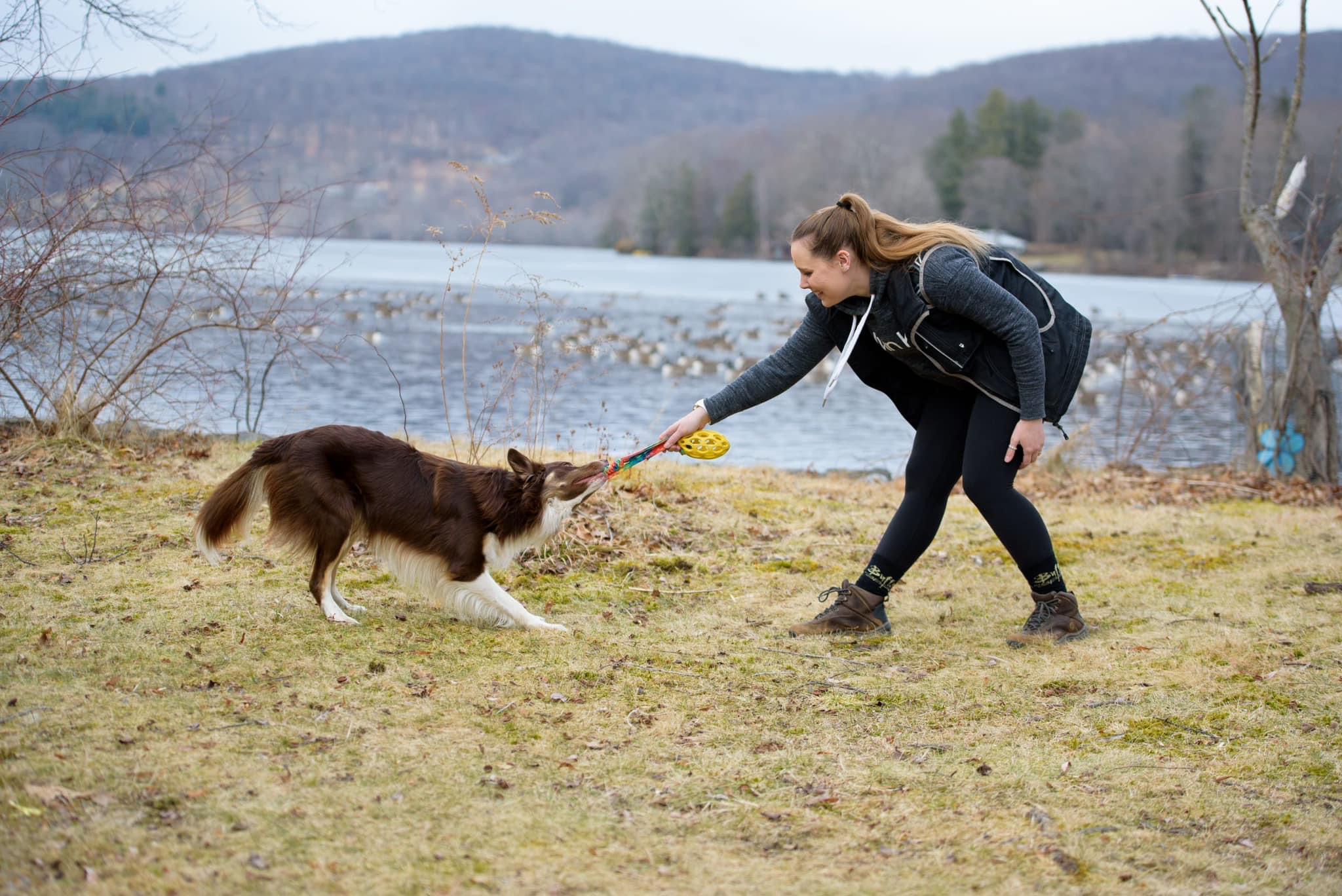 Instructor: Bronagh Daly


