Course Details
Running an agility course is all about clarity. The clearer we are, the easier a time our dog has understanding our handling and the better we do on course together.
This leads us to the two most important aspects of almost all handling techniques: forward focus and come to hand cues. Without these, dogs can often either lack the confidence to drive ahead or easily ping away/shop for obstacles.
Our dogs need to know when they should be driving ahead or taking the obstacle in front of them and when they should be coming into you. Without that clarity, handling can become very challenging. And that is what is class is all about!
Throughout this class, you and your dog will learn how build a clear understanding of both skills: forward focus/driving ahead and come to hand/coming into you. Exercises will address both how to build these skills on a verbal and on a specific arm position. Once you and your dog have mastered both, handling any course will seem like a breeze!
This class is appropriate for all levels that want to fine tune their handling and their dogs’ understanding of it! Exercises in this course will be applicable both to teams who are just starting out on their agility journey as well as those that are already running full courses.
Teaching approach:
New lectures will be released at the top of each week. The lectures will be a mix of written instruction and video example.
Feedback will be given as a combination of written feedback and video/screen recorded feedback when helpful. Using the combination, we will be able to go through your videos in great detail, getting the most out of each week!
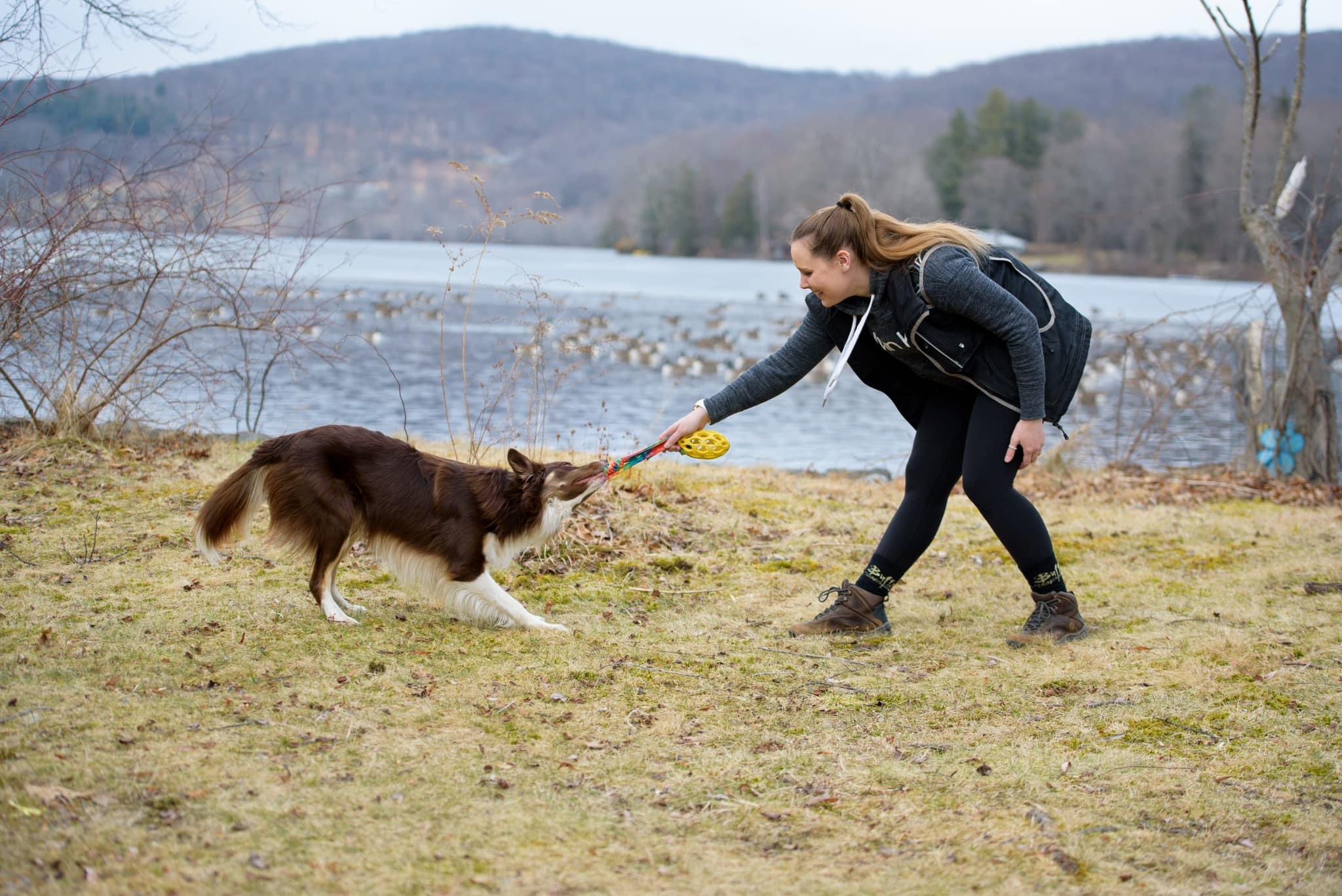
Guest Instructor: Bronagh Daly
Syllabus
Week One
- Forward focus and come to hand – WHY?
- Arm positions - clarity
- Picking verbals
- Building value for coming to your hand
- Building value for going ahead
Week Two
- Flatwork exercises come to hand
- Flatwork exercises forward focus
- Forward focus at the start line – foundation
Week Three
- Adding obstacles – forward focus
- Adding obstacles – come to hand
- Forward focus at the start line – diversifying
Week Four
- Discrimination – forward focus
- Discrimination – come to hand
- Forward focus at the start line – lateral
Week Five
- Either/or forward focus/come to hand with jump
- Either/or forward focus/come to hand with tunnel
- Forward focus at the start line – forwards
Week Six
- Delayed reinforcement – come to hand
- Delayed reinforcement – forward focus
- Where do you go from here?
Prerequisites and Equipment
Dogs will need solid toy and/or food skills. Dogs will need to be able to work around a toy or bowl of food on the ground, so teams with clear toy/food markers will get the most out of the class.
Needed:
- Easy to see food/toys
- Cone (or equivalent)
- At least two jumps, three is possible
- Tunnel (any size)
Sample Lecture
When it comes to successfully and comfortably completing an agility course, clarity is the most important thing. Our dogs need to know when they should be taking the obstacle ahead of them and when they should be turning or coming into us. The most common errors that I see on agility courses is when dogs lack this clarity. So how do we achieve it?
1. Clear understanding of handlers’ arm positions is a big one!
When you raise your arm up in the air, dogs will naturally tend to extend/jump bigger. When you bring your arm low towards your body, dogs will naturally pay more attention. However, as we get further into our agility journey, we often muddy this. As a result, this can often cause our canine teammates to guess at what we mean instead of know with full clarity. And that can lead to errors on course or us over-handling. This is something we’re going to mitigate as we move through class! That means from here on out, we’re going to have to be mindful of exactly what arm positions we’re using as we move through the exercises in this class. That leads us to…
2. Clear and predictable verbals for coming into us/bypassing something and carrying on ahead/taking what they’re looking at.
Dogs all have their preferences. Some prefer to extend and carry ahead without us, while some prefer to stick with us. This can occur due to what they find most rewarding, but it can also be a combination of not being sure when they should be doing either of these things. This can then cause a lack of confidence for one or the other (and sometimes even both!). That’s where verbals can really help! So to assist our dogs (and ourselves!), we’re going to be teaching our dogs a come to hand verbal and a go ahead verbal. And I strongly believe in training these two verbals together. Afterall, if they’re lacking a clear understanding of one of these concepts, their understanding for the other isn’t going to be as strong. To truly master these skills, they need to feel confident about both! To be confident in going ahead, they need to also be confident in coming into you. That way we eliminate any need for guessing what our handling is trying to convey.
3. Now, at the same time, we’re also going to be focusing on startlines—the place a lot of dogs can struggle to focus ahead, particularly if we’re behind them or lateral.
There are so many things going on at the startline! People and dogs milling around behind us, other teams finishing their own runs, big excited feelings. This can cause dogs to be unsure of where to focus. This can cause them to focus too much on the obstacles ahead or too much on us. This is why we’re going to train a focus cue. We’re going to teach our dogs that when we point to something and ask them to focus, they should stare at that thing. And if we don’t ask them to focus on something and instead have our hand low, they should come into us. (Hello
Snooker skills!) And just a side note: this skill can also be a huge help for teams that commonly knock that first bar or run by it.
Okay, now that we’ve discussed all that we’re going to cover and why…let’s get to some arm position homework and discuss what those are going to look like!
Testimonials & Reviews
A sampling of what prior students have said about this class ...
Bronagh was wonderful! She was very responsive and detailed in her coaching. Her videos and written descriptions were easy to follow and build really nicely from one week to the next. I sure hope she returns as an instructor!
I'm a pretty new trainer, and this is only my second class. I am already hooked! This process helped me build my understanding of how behaviors are back-chained, and help me start to think through that process on my own. Thanks so much! Bronagh was fabulous!
This was the course I didn’t know I needed. Great skills included and very appropriate for my dog at this point for her agility foundation skills. I would recommend it!
This course was a lot at first but she was so great at helping us go at our on pace! Great class.
Registration
Next session starts: April 1, 2026Registration starts: March 22, 2026Registration ends: April 15, 2026
Registration opens at 9:30am Pacific Time.
AG265 Subscriptions
![]() Gold |
![]() Silver |
![]() Bronze |
|
|---|---|---|---|
| Tuition | $ 260.00 | $ 130.00 | $ 65.00 |
| Enrollment Limits | 12 | 25 | Unlimited |
| Access all course lectures and materials | ✔ | ✔ | ✔ |
| Access to discussion and homework forums | ✔ | ✔ | ✔ |
| Read all posted questions and answers | ✔ | ✔ | ✔ |
| Watch all posted videos | ✔ | ✔ | ✔ |
| Post general questions to Discussion forum | ✔ | ✔ | ✖ |
| Submit written assignments | ✔ | ✖ | ✖ |
| Post dog specific questions | ✔ | With video only | ✖ |
| Post videos | ✔ | Up to 2 | ✖ |
| Receive instructor feedback on |
|
|
✖ |
Find more details, refund policies and answers to common questions in the Help center.


