If you're moving into AKC or CKC Rally Advanced or Excellent, jumps are a big part of the picture. Your dog needs to be confident enough to take a jump on cue, from a distance, and with you moving alongside them - but also restrained enough not to take it when you haven't asked. That's a lot to ask, and it starts with making sure your dog actually has real value for the jump itself.
Here's how I build that with my dogs.
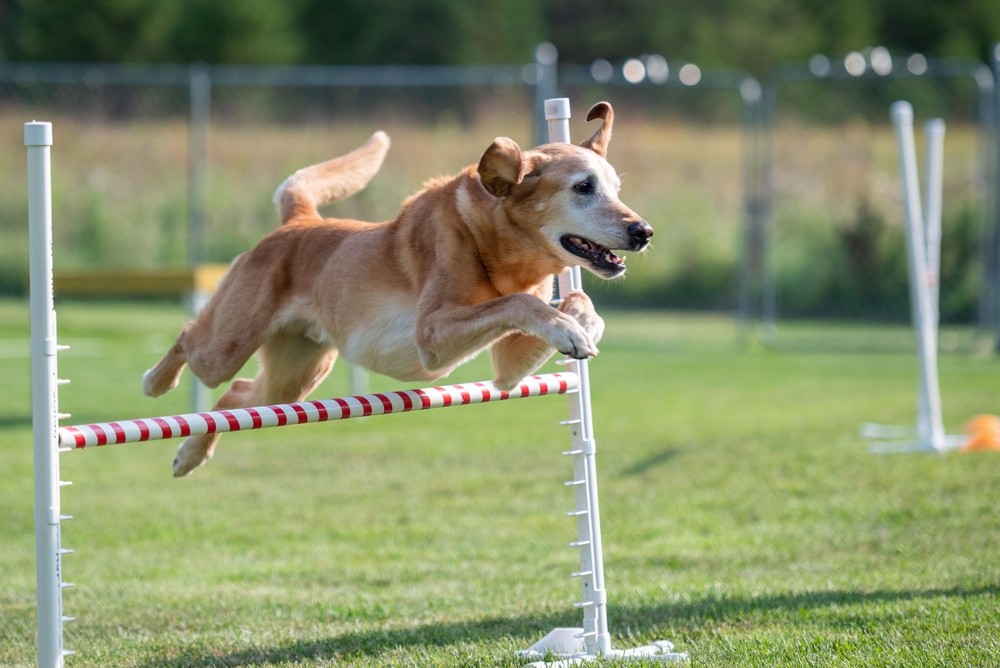
Start at the Jump
I begin by rewarding any interest in the jump at all - looking at it, stepping toward it, sniffing it. This might seem like a low bar, but it matters. You're teaching your dog that the jump predicts good things before you've asked them to do anything with it. A dog who associates the jump with rewards is going to be a lot more enthusiastic about taking it later than a dog who learned to jump because you lured them over it a few times.
I mark the moment the dog shows interest and toss the treat over the jump. That treat toss does two things: it rewards the behavior, and it resets the dog on the other side so they naturally approach the jump again. You're building repetitions without it feeling like drilling.
After a few reps, I raise my criteria. Now the dog has to actually move toward the jump to earn the reward. Then I wait a little longer - they have to get closer. Eventually, I hold out until after they jump to mark and treat. I'm shaping the jump in small steps rather than waiting for the whole thing from the start.
The goal at this stage is a dog who is genuinely excited about the jump. Not a dog who jumps because you asked nicely. A dog who sees the jump and thinks "yes, that thing, I want to do that."
This video shows me working on the same concept, but with a broad jump.
Test the Value
Once the dog has the idea, I start stepping away from the jump. This is where you find out how much value your dog actually has for it. A dog with real jump value will leave you and go take it. If your dog hesitates, keeps checking back with you, or loses interest when you add a little distance, that's useful information. It means you need more reps closer in before you move on. There's no rush here.
When things are going well, I start moving alongside the jump the way I would on an actual Rally course. This is an important piece that handlers sometimes skip. Jumping while you're stationary next to the jump is a different picture than jumping while you're moving. Get your dog comfortable with both.
Putting the Jump on Cue
Here's where it gets interesting. Advanced and Excellent course will often use the jump as a distraction. It's sitting there in the ring, and your dog has to walk past it, heel near it, and not take it unless you ask. So once your dog loves the jump, you have to put some control on that enthusiasm.
This is the part that trips up a lot of handlers, because you've just spent time building excitement for the jump and now you're asking your dog to show some restraint. The key is that you only give the jump cue when your dog is checked in with you and paying attention. If they're staring at the jump and offering it on their own, they don't get to jump. You wait.
Excel was very motivated by the jump and really wanted to offer it. You can see him working hard to figure out the rules. That effort is actually a good sign - it means the value is there. Now we're just teaching him that the jump is only available when I ask for it.
Some dogs will need a lot of repetitions of this. Others won't find the jump quite so magnetic. That's fine. Meet your dog where they are and give them what they need.
The Dog Who Won't Jump and the Dog Who Can't Stop
Most handlers end up with one of two situations: a dog who is hesitant about the jump, or a dog who is so enthusiastic they can barely contain themselves.
For the hesitant dog, go back to basics. Are you starting close enough? Is your treat placement reinforcing movement toward the jump? Sometimes hesitation is about the jump height - dropping it to the lowest setting or even laying the bar on the ground can help a dog who is worried. Build value slowly and don't move forward in the progression until your dog is actively seeking the jump out.
For the enthusiastic dog, the work is all about stimulus control. Your dog has to learn that their excitement doesn't get to make decisions - you do. Practice being near the jump without cueing it. Reward your dog for checking in with you when the jump is in sight. Make "not jumping" just as reinforcing as jumping. It takes patience, but a dog with real value for the jump and solid stimulus control is exactly what you want walking into an Advanced or Excellent ring.
Adding Distance
Once your dog understands that the jump is on cue and not a self-serve option, you can start building distance in both directions. In Advanced and Excellent, your dog will need to leave you and go out laterally and in front to take the jump, so you want to proof that from multiple angles.
Start closer than you think you need to. A lot of handlers jump ahead to sending their dog from several feet away before the dog is really ready, and then they get into the ring and the dog pulls up short or blows past the jump entirely. Build the distance gradually and let your dog's confidence guide the pace.
Don't forget to practice having your dog come back to heel position after the jump, and heeling past the jump without taking it. Both of those skills will come up on course, and both are worth training separately before you put them into a full sequence.
Jump skills like these are part of the foundation work we cover in my 3-week FDSA course, Rally Skill Builder: Advanced and Excellent. The course is designed for handlers who are getting ready to move up from Novice, or who want to make sure their foundation is solid before they start running Advanced and Excellent courses. We work through the skills you actually need -- not just the signs, but the underlying behaviors that make everything else easier.
Registration opens June 22nd and the class starts July 1st. I'd love to have you join us.